
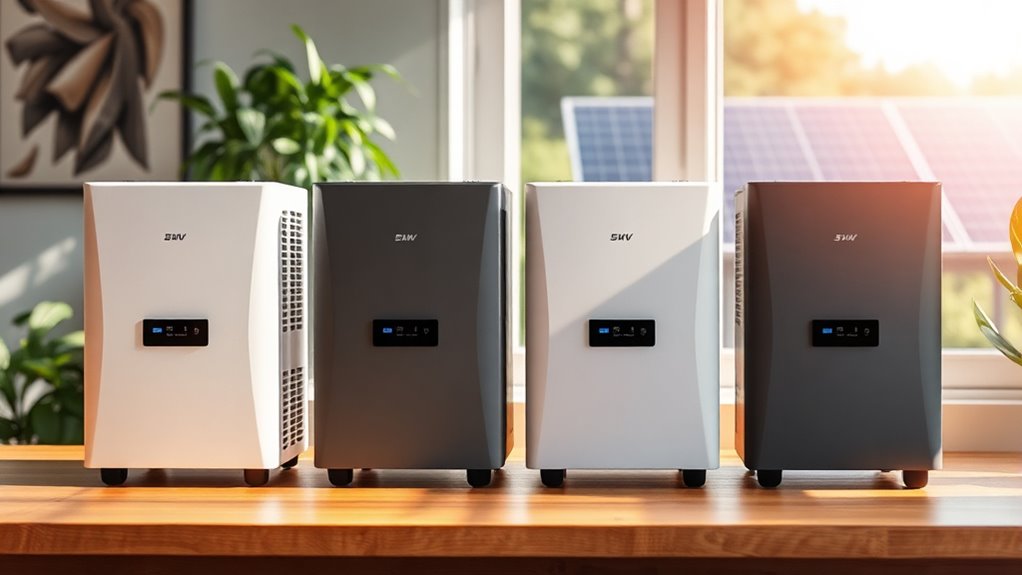
4 best 5kw inverters for home solar usa 2024
If you’re looking for a reliable 5kW inverter for your home solar system in the USA in 2024, you’ve got some great options to consider. These inverters are perfect for maximizing your solar setup, ensuring efficient energy conversion and dependable performance.
The LiTime 5000W Hybrid Solar Inverter offers a pure sine wave output with parallel support, which is great for expanding your system later on.
Meanwhile, the LiTime 5000W Inverter Charger brings split-phase 120/240V capability, making it super versatile for different home power setups.
ECO-WORTHY’s 5000W model stands out with seamless backup power and professional-grade safety features that give you peace of mind.
On the other hand, PowMr’s 5kW inverter includes robust cooling and LiFePO4 battery support, making it a solid choice for long-term use.
Take a closer look to find the best fit for your specific power needs and solar goals.
LiTime 5000W Hybrid Solar Inverter, 48VDC to 110V/120VAC (Support Parallel)
The LiTime 5000W Hybrid Solar Inverter offers a powerful solution for managing home or small business energy efficiently. Its hybrid design supports both lithium and lead-acid batteries, ensuring flexibility in your power storage options. This inverter delivers a pure sine wave output, providing clean and stable electricity for sensitive devices.
Designed for easy monitoring, the built-in LCD display keeps you informed about system performance. Its 100A MPPT solar charger and 40A AC battery charger work together to optimize solar energy use and battery charging. The unit supports 48V input and outputs 120VAC, integrating smoothly with your existing solar setup.
Maintenance is straightforward due to its all-in-one construction, reducing complexity and installation time. The inverter also supports parallel connection of up to six units, allowing scalable power output up to 30kW for growing energy needs.
While it’s relatively heavy and limited to 48V battery systems, the LiTime inverter’s robust build and multiple operating modes provide reliable backup power and efficient energy management.
Best for: homeowners and small businesses needing a versatile hybrid solar inverter compatible with lithium and lead-acid batteries.
What We Like:
- Integrated 100A MPPT solar charger and 40A AC battery charger for efficient energy use
- Parallel support for up to six units, enabling scalable power capacity
- Pure sine wave output ensures clean and stable power supply
- User-friendly LCD display for easy system monitoring
- Multiple operating modes including UPS functionality for seamless power backup
Specification:
| Feature | Details |
|---|---|
| Manufacturer | LiTime |
| Continuous Power | 5000W |
| Peak Surge Power | 10000W |
| Battery Voltage Input | 48V DC |
| AC Output Voltage | 110V/120V AC |
| MPPT Solar Charger | 100A |
| AC Battery Charger | 40A |
| Parallel Capability | Up to 6 units (30kW total) |
| Weight | 30.9 lb (14 kg) |
LiTime 5000W Solar Inverter Charger, 48V Split Phase 120V/240V, All in One
The LiTime 5000W Solar Inverter Charger offers a compact, all-in-one solution for managing home solar power efficiently. Its hybrid design integrates a pure sine wave inverter, MPPT solar charge controller, and AC battery charger, simplifying your energy system. This reduces the need for multiple devices and cuts down on installation complexity.
Designed to support 48V lithium or lead-acid batteries, it provides flexible energy storage options. The split-phase 120V/240V output suits a variety of household needs, delivering stable power for everyday use. You can even connect up to six units in parallel, scaling your system up to 30 kW.
Maintenance is straightforward due to its integrated design and clear LCD display, which helps monitor system status and adjust charging schedules. This feature enables you to optimize grid usage, lowering electricity costs while protecting your batteries with built-in safety mechanisms.
Overall, this inverter charger improves energy management by combining essential functions in a single, reliable device. Its compact size and user-friendly controls make it a practical choice for homes or small businesses.
Best for: homeowners or small businesses looking for a scalable, efficient hybrid solar inverter charger with advanced energy management.
What We Like:
- Combines inverter, MPPT controller, and battery charger in one unit
- Supports parallel connection for up to 30 kW total power
- Split-phase 120V/240V output for versatile home use
- Easy-to-read LCD for monitoring and scheduling
- Built-in protections ensure safe, reliable operation
Specification:
| Feature | Details |
|---|---|
| Manufacturer | LiTime |
| Power Output | 5000W |
| Battery Voltage | 48V (Lithium or Lead-Acid) |
| Solar Charge Controller | 100A MPPT |
| AC Battery Charger | 40A |
| Output Voltage | Split-phase 120V/240V |
| Parallel Capability | Up to 6 units (30 kW total) |
| Dimensions | Compact (exact size not provided) |
| Display | LCD |
ECO-WORTHY 5000W 48V Solar Inverter Charger
The ECO-WORTHY 5000W 48V Solar Inverter Charger delivers dependable power for off-grid living and backup needs. It converts 48V DC from your solar panels or batteries into clean 120V AC electricity, ensuring your sensitive devices run smoothly. With its pure sine wave output, you get stable and reliable power without interference.
This inverter charger features a built-in 100A MPPT solar charge controller, optimizing solar energy use and extending battery life. It supports hybrid charging modes, combining solar and mains power, and offers UPS functionality to keep critical devices running during outages. The system is scalable, allowing up to six units to be connected in parallel for larger power demands.
Designed for lead acid and LiFePO4 batteries, it includes comprehensive protection features to prevent damage and maintain safety. An LCD screen provides real-time data, making monitoring and maintenance straightforward. For best results, professional installation is recommended to ensure safety and peak performance.
Best for: Homeowners and off-grid enthusiasts needing a flexible, high-capacity solar inverter charger with advanced charging options and backup power support.
What We Like:
- Clean and stable pure sine wave output
- Efficient 100A MPPT solar charge controller
- Scalable system with parallel connection support
- Supports multiple battery types with built-in protections
- User-friendly LCD for real-time monitoring
Specification:
| Specification | Details |
|---|---|
| Manufacturer | ECO-WORTHY |
| Power Output | 5000W |
| Battery Voltage | 48V |
| Solar Charge Controller | 100A MPPT |
| AC Battery Charger | 40A |
| Output Voltage | 120V AC |
| Battery Compatibility | Lead acid, LiFePO4 |
| Parallel Capability | Up to 6 units |
| Display | LCD screen |
PowMr 5000W Hybrid Solar Inverter 48VDC Pure Sine
Experience reliable and powerful energy management with the PowMr 5000W Hybrid Solar Inverter. Designed to handle heavy home and industrial loads, it ensures your appliances run smoothly without interruption. This inverter delivers stable 110/220V AC power, making it ideal for demanding environments.
The built-in 120A MPPT charge controller optimizes solar charging efficiency and supports multiple battery types such as LiFePO4 and AGM. You can easily switch between solar-only, utility, or hybrid charging modes, giving you full control over your energy sources. This flexibility helps reduce energy costs and reliance on the grid.
Durability is key with dual cooling fans and an enhanced toroidal transformer, which work together to extend the inverter’s lifespan. Its robust design includes protections against overload, short circuits, and voltage fluctuations, reducing maintenance needs and ensuring safety.
While it weighs 60 lb, requiring careful installation, the PowMr hybrid inverter offers a dependable solution for stable off-grid or grid-interactive power. Its versatile battery compatibility and advanced features make it a practical investment for managing renewable energy.
Best for: homeowners and small industrial users seeking a reliable, high-capacity hybrid solar inverter with flexible battery support for stable power generation.
What We Like:
- High continuous output of 5000W with 15000W surge power handles heavy loads effortlessly.
- Integrated 120A MPPT controller enhances solar charging efficiency and battery management.
- Durable build with dual fans and toroidal transformer ensures long-term reliability.
- Multiple charging modes offer flexible energy use and cost savings.
Specification:
| Feature | Details |
|---|---|
| Manufacturer | PowMr |
| Power Output | 5000W continuous, 15000W surge |
| Battery Voltage | 48V DC |
| MPPT Charge Controller | 120A |
| Cooling System | Dual cooling fans |
| Weight | 60 lb (27.2 kg) |
| AC Output Voltage | 110/220V |
| MPPT Input Voltage Range | 60–105V DC |
Factors to Consider When Choosing 5kw Inverters for Home Solar USA 2024

When choosing a 5kw inverter for your home solar system, you’ll want to focus on key factors like power output capacity and battery compatibility. Make sure the inverter supports parallel connections and offers flexible charging and discharging modes.
Don’t forget to prioritize safety and protection features to keep your system running smoothly. These aspects can make a big difference in the long-term reliability and efficiency of your setup.
Power Output Capacity
Start by matching the inverter’s continuous output rating to your household’s combined wattage during peak usage. A 5 kW inverter supplies about 5000 W continuously, so make certain your total appliance load doesn’t exceed this.
Next, check the surge capacity—it should be at least twice the continuous power to handle motor starts in refrigerators or pumps. Also, verify if the inverter supports paralleling units if you plan to expand beyond 5 kW later.
Pay attention to the inverter’s VA rating and power factor, as these affect usable real power. Finally, consider thermal derating: high temperatures or elevation can reduce output.
Battery Compatibility Options
Matching your inverter’s power output to your home’s needs is just one part of the equation. You also need to confirm the inverter supports your battery’s nominal voltage—48 V is common for 5 kW systems—to guarantee proper DC input and charging regulation.
Check if it’s compatible with your battery chemistry, like LiFePO4 or lead-acid. Also, see whether it offers programmable charging profiles or a user mode for precise voltage and cutoff settings.
Compare the inverter’s maximum charge and discharge currents to your battery bank’s recommended rates. This helps avoid overcurrent or slow charging issues.
Don’t forget to verify battery management features like low-voltage disconnect, over-voltage protection, and temperature compensation. These protect your battery and guarantee long-term reliability.
Parallel Connection Support
Although many 5 kW inverters work well solo, you’ll need models that support true parallel operation if you want to combine multiple units for higher capacity or split-phase setups. Look for inverters that synchronize AC output, phase, and frequency to prevent harmful circulating currents.
Check the maximum number of units allowed in parallel and their combined continuous and peak power limits to make certain your system meets your energy demands. Also, verify the communication method—like CAN or RS485—and cabling requirements for stable load sharing and fault coordination.
Make sure the inverter can maintain waveform and phase synchronization during dynamic loads or grid loss. Finally, consider parallel system features such as automatic load balancing and individual unit monitoring to optimize efficiency and prolong your system’s lifespan.
Charging And Discharging Modes
Choose a 5 kW inverter that supports versatile charging and discharging modes to optimize how you manage solar, battery, and grid energy. Look for inverters offering multiple charging modes like PV-only, hybrid, and grid-priority. This way, you can prioritize energy sources based on your needs.
Check the AC battery charger current and MPPT PV charge current ratings to guarantee charging speeds match your battery capacity. Timed charging and discharging features are also handy. They let you schedule grid charging during off-peak hours and discharge during peak times, which helps maximize savings.
Make sure the inverter supports UPS and automatic transfer functions for seamless power switching during outages. Finally, confirm compatibility with your battery chemistry. Also, ensure the charge/discharge parameters are programmable to protect battery health and extend lifespan.
Safety And Protection Features
When selecting a 5 kW inverter for your home solar setup, prioritizing safety and protection features is essential to safeguard your system and property. Make sure the inverter has overload, over-current, and short-circuit protection with automatic shutdown to prevent wiring damage and fire risks during faults or peak loads.
Look for over-voltage and under-voltage protection on both AC and DC sides, with adjustable trip thresholds to shield batteries and appliances from grid or PV irregularities. Over-temperature protection combined with active cooling prevents thermal runaway by throttling or shutting down at high temperatures.
Check that the inverter includes built-in battery management—low-voltage cut-off, charge limits, and correct chemistry profiles—to maintain battery health. Finally, verify anti-islanding, ground-fault protection, and necessary safety certifications to comply with local codes and reduce liability.
Efficiency And Energy Management
Since energy efficiency directly impacts your solar system’s performance and savings, you’ll want a 5 kW inverter with high peak and continuous efficiency ratings—ideally between 90% and 95%—and low standby consumption to minimize losses during conversion and idle times.
Look for hybrid inverters with MPPT solar charge controllers and configurable timed charging. These let you schedule grid charging during off-peak hours and discharge during peak rates, cutting utility bills.
Make sure your inverter supports advanced energy management modes like PV-priority and mixed-load. That way, the system automatically optimizes solar, battery, and grid use for maximum self-consumption.
If you plan to expand, check for parallel capability and scalable output. Also, verify built-in UPS functions and fast transfer switching with protections to maintain efficiency and safeguard your system under varying conditions.
Warranty And Return Policy
Beyond efficiency and energy management, you’ll want to pay close attention to the warranty and return policy when selecting a 5 kW inverter. Confirm the warranty length, typically 1–5 years, and verify it covers both inverter electronics and integrated MPPT/charger components.
Check what failures are covered—parts, labor, shipping, replacements—and note exclusions like physical damage or improper installation. It’s also good to understand if repairs require factory returns, on-site service, or authorized centers. Don’t forget to ask about repair turnaround times.
Review the seller’s return policy window, usually 14–30 days, including restocking fees, shipping costs, and item condition for refunds. Lastly, make sure you complete warranty registration properly by keeping proof of purchase, serial numbers, and installation records. This way, you avoid denied claims later on.
Frequently Asked Questions
How Do 5kw Inverters Affect Home Insurance Premiums?
Installing a 5kW inverter might lower your home insurance premiums since it reduces reliance on the grid and boosts energy efficiency.
However, you should check with your insurer, as policies and discounts can vary widely.
It’s always a good idea to ask because some companies might offer special rates or benefits when you add renewable energy equipment.
Can 5kw Inverters Be Integrated With Smart Home Systems?
About 70% of modern 5kW inverters can integrate with smart home systems. You’ll easily monitor energy use and optimize efficiency by connecting your inverter to apps or voice assistants.
This connection really boosts your home’s automation and energy management. It’s a smart way to keep everything running smoothly without much hassle.
What Maintenance Is Required for 5kw Solar Inverters?
You’ll need to regularly clean the inverter’s vents and check for firmware updates. It’s also important to inspect wiring connections to make sure everything is secure.
Keep an eye on performance through the display or app. This way, you can catch any issues early on.
Scheduling a professional inspection annually is a smart move. It helps keep everything running smoothly and efficiently.
Are There Any Tax Incentives for Purchasing 5kw Inverters?
Yes, you can get tax incentives like the federal Investment Tax Credit (ITC). This credit covers a percentage of your solar system cost, including the inverter.
Be sure to check local and state programs too. They often offer additional rebates or credits that can save you even more.
How Loud Are 5kw Inverters During Operation?
Think of a whisper in a quiet room—that’s how loud 5kW inverters usually are. You won’t notice their soft hum during operation.
Conclusion
Choosing the right 5kW inverter for your home solar setup is essential. It’s no coincidence that all top picks offer hybrid capabilities, pure sine wave output, and reliable voltage support.
Whether you lean toward LiTime, ECO-WORTHY, or PowMr, you’ll find these inverters are designed to maximize efficiency and durability. They’re built to last and keep your system running smoothly.
So, when you invest in a quality inverter, you’re not just powering your home—you’re ensuring your solar system works seamlessly day after day. A good 5kW inverter plays a crucial role in optimizing your solar energy usage, helping you save on electricity bills while promoting clean, renewable power.
In short, choosing the best 5kW inverter for home solar in the USA means picking a device that balances performance, reliability, and smart features. This way, your solar setup delivers consistent energy and peace of mind for years to come.


