3 Best Backpacking Solar Power Banks for 2027
For 2027, choosing the best backpacking solar power bank means balancing efficiency, durability, and versatility. Whether you’re hiking, camping, or just need reliable outdoor power, having a solar charger that keeps your devices running is a game-changer. Lightweight models with fast charging, rugged designs with big battery capacity, or versatile combos with foldable panels all have their perks.
For high-efficiency solar charging with dual USB-C and USB-A ports, go for the BigBlue 28W. It’s perfect if you want something lightweight and fast for your outdoor adventures.
Need something tough with a massive 24,000mAh battery, USB-C fast charging, and an LED flashlight? ToughTested has got you covered.
If you want a versatile option, the 2-in-1 model offers a built-in 10,000mAh battery, a foldable panel, and PD 20W output. Keep thinking about capacity, ports, and durability to find the perfect match for your backpacking needs.
| Image | Name | Editor's Rating | Price |
|---|---|---|---|

|
|
||

|
|
||

|
|
BigBlue 28W High-Efficiency Solar Panel Charger with Dual USB-C and USB-A
- Advanced Performance: BigBlue 28W portable solar charger provides 20% more power from every ray, thanks to...
- Upgraded Triple-Port: Dual USB-C and one USB-A ports deliver a maximum output of 5V/3A each, collectively achieving...
- High-Efficiency & IP44 Waterproof: 28W USB solar panel phone charger converts 25.4% sunlight into free energy...
- Ultra-Portable Emergency Solar Charger: Engineered for outdoor camping/hiking and emergency power supply, BigBlue...
- Universal Power on the Go: Charge your smartphones, power banks, GPS, flashlight and small electronics seamlessly...
The BigBlue 28W High-Efficiency Solar Panel Charger offers a practical solution for charging devices on the move. Its lightweight, foldable design makes it easy to carry, fitting compactly into your backpack without adding bulk. This charger delivers reliable power by harnessing sunlight efficiently, so you can stay connected even in remote locations.
With dual USB-C and USB-A ports, it supports charging multiple devices at once, making it convenient for busy outdoor days. The panel’s IP44 rating protects it against rain and fog, while smart IC technology ensures your electronics charge safely without damage. This means you can focus on your adventure without worrying about your gear.
Maintenance is simple due to its durable, weather-resistant surface. However, keep in mind that the USB junction box is not waterproof, so avoid heavy rain exposure. Also, it doesn’t include an internal battery, so it cannot store energy or power larger devices like laptops.
Best for: Outdoor enthusiasts and emergency preppers needing a compact, efficient solar charger for smartphones and small electronics.
What We Like:
- High 25.4% conversion efficiency for dependable solar charging
- Dual USB-C and USB-A ports enable simultaneous multi-device charging
- Weather-resistant IP44 panel with smart IC for safe, durable use
- Lightweight and foldable design for easy portability
Specification:
| Feature | Details |
|---|---|
| Manufacturer | BigBlue |
| Dimensions | 11 x 6 x 1.4 inches (folded) |
| Weight | 671 grams (1.48 lbs) |
| Material | N-type monocrystalline cells |
| Color Options | Not specified |
ToughTested 24000mAh Solar Power Bank, LED Flashlight, USB-C Fast Charging
- MASSIVE 24000MAH CAPACITY: Stay powered for days with enough energy to charge smartphones 8-10 times. Perfect for...
- HIGH-EFFICIENCY SOLAR CHARGING: Integrated solar panels convert sunlight to backup power. Provides a reliable...
- MULTIPLE DEVICE CHARGING: Power three devices at once with a high-speed 18W USB-C PD port, a USB 3.0 port, and a...
- FAST 18W USB-C POWER DELIVERY: Optimized for modern tech like MacBooks and tablets. The high-speed USB-C PD port...
- IP66 RUGGED DURABILITY: Fully waterproof, dustproof, and shockproof. This portable solar power bank is engineered...
Experience reliable power anywhere with the ToughTested 24000mAh Solar Power Bank. Its rugged design is built to withstand tough environments, ensuring your devices stay charged during outdoor adventures. Fast USB-C charging lets you quickly power up your gadgets, reducing downtime.
This power bank offers IP66/IP67 waterproof, dustproof, and shockproof protection, making it perfect for camping, hiking, and other demanding activities. The high-capacity lithium-ion battery supports simultaneous charging of three devices through USB-C PD and USB 3.0 ports, keeping multiple devices ready to use.
Solar panels provide a convenient way to recharge off-grid, though solar charging is slower than wired methods. The built-in LED flashlight with four modes adds safety and utility for emergency situations. Despite its compact 16-ounce weight, the unit’s size may not fit all pockets or small bags.
Maintenance is straightforward: keep the solar panels clean for optimal energy absorption and store the power bank in a dry place when not in use. This ensures lasting performance and readiness whenever you need it.
Best for: Outdoor enthusiasts and travelers needing a durable, high-capacity solar power bank with fast charging and emergency lighting.
What We Like:
- Rugged waterproof and shockproof design for harsh conditions
- High-capacity battery with simultaneous fast charging for multiple devices
- Solar panels enable off-grid recharging
- Built-in LED flashlight with multiple emergency modes
Specification:
| Feature | Details |
|---|---|
| Manufacturer | ToughTested |
| Capacity | 24000mAh |
| Charging Ports | USB-C PD (18W), USB 3.0 |
| Protection | IP66/IP67 waterproof and dustproof |
| Weight | 16 oz (0.45 kg) |
| Dimensions | Not specified |
2-in-1 Solar Panel Charger, 10000mAh Solar Power Bank, Foldable PD 20W
- SOLAR + BATTERY POWER: 15W solar panel charger + 10000mAh battery. Day solar charging, night battery backup. This...
- 6 DEVICES AT ONCE: 2 USB-A, 2 USB-C, 1 built-in iOS cable, 1 built-in USB-C cable. Built-in USB-C recharges the...
- PD 20W FAST CHARGING: iPhone to 65% in 30 minutes. This solar charger for cell phone works with iPhone, iPad...
- SMART DISPLAY + LED: Digital display shows exact battery percentage. 3-mode LED: steady, slow flash, fast flash...
- PORTABLE & IPX5: 1.45 lbs, folds to 8.26 × 4.72 × 1.61 in. This foldable solar panel is IPX5 water and dust...
Charge your devices effortlessly wherever your adventures take you with the 2-in-1 Solar Panel Charger. Its foldable design combines a high-efficiency 15W solar panel with a 10,000mAh lithium polymer battery, ensuring reliable power even in remote locations. This charger solves the common problem of running out of battery when off the grid by delivering fast, portable energy.
You can power up to six devices at once using the built-in USB-C, iOS cable, and multiple USB ports. The fast PD 20W output means your devices charge quickly, saving you time. Its lightweight and IPX5 water-resistant construction makes it durable enough for outdoor conditions, whether hiking or camping.
Maintenance is simple—just keep the solar panels clean for optimal energy absorption. The digital display clearly shows battery levels, while the LED modes provide emergency lighting and SOS signals, adding safety on your trips. Included carabiners and a lanyard make carrying convenient and secure.
Although solar charging is slower in low light, the battery offers enough capacity for most daily needs. Note that built-in cables may not fit every device or case, so additional cables might be necessary.
Best for: Outdoor enthusiasts and travelers who need a durable, versatile solar charger to power multiple devices on the go.
What We Like:
- Efficient 15W solar panel paired with a 10,000mAh battery for reliable off-grid charging
- Fast PD 20W output supports quick charging of multiple devices simultaneously
- IPX5 water-resistant design with emergency LED lighting and SOS feature
- Built-in cables and multiple ports reduce the need to carry extra accessories
- Lightweight, foldable design with carabiners and lanyard for easy transport
Specification:
| Feature | Details |
|---|---|
| Manufacturer | Not specified |
| Dimensions | Foldable design (compact) |
| Weight | Lightweight (exact weight not specified) |
| Battery Capacity | 10,000mAh lithium polymer |
| Solar Panel Power | 15W |
| Output Power | PD 20W |
| Ports | USB-C, USB-A, built-in iOS cable |
| Water Resistance | IPX5 |
| Included Accessories | Carabiners, lanyard |
Factors to Consider When Choosing a Backpacking Solar Power Bank
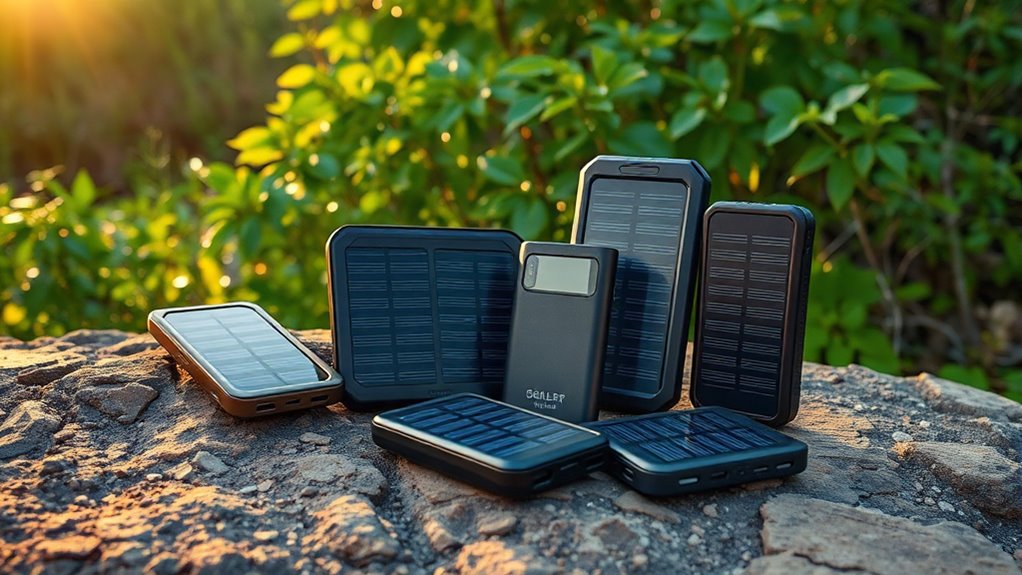
When choosing a backpacking solar power bank, you’ll want to focus on battery capacity to keep your devices charged longer. Check the solar panel’s efficiency, the types of ports and cables available, and how durable and weatherproof the unit is.
Also, don’t forget to take into account weight and portability since you’ll be carrying it on your adventures. It makes a big difference when you’re out there hiking or camping, trust me!
Battery Capacity Importance
Understanding battery capacity plays a crucial role in selecting the right solar power bank for backpacking. For multi-day trips, you’ll want at least 10,000–20,000 mAh to recharge your smartphone multiple times or charge several small devices.
Keep in mind, the advertised mAh is at a nominal voltage, so the actual USB output at 5 V is about 70–80% of that after conversion losses. Higher capacity means added weight and bulk, so balance your power needs against your pack-weight goals—each extra 10,000 mAh typically adds several hundred grams.
If you plan to charge power-hungry devices like tablets or satellite communicators, look for bigger capacity and check wattage or Power Delivery support, since mAh alone won’t cover that. For day hikes, smaller 5,000–10,000 mAh packs charge faster and are easier to carry.
Solar Panel Efficiency
Although battery capacity matters, solar panel efficiency ultimately determines how quickly and effectively your power bank recharges in the field. Efficiency measures how much sunlight converts into electricity, so higher-efficiency panels (around 23–25%) generate more power per square inch than those at 15%.
This really matters when space is tight or conditions aren’t ideal. Advanced monocrystalline cells perform better in partial shade and low light, which is a big plus.
Remember, real-world output usually drops 10–30% below lab-rated efficiency because of factors like angle, temperature, and weather.
Also, flexible or thin panels often sacrifice durability and efficiency for portability. That can slow charging over multiple days, so keep that in mind.
When choosing, try to balance panel efficiency with physical size. Sometimes a larger, slightly less efficient panel can out-produce a smaller high-efficiency one, depending on your backpacking energy needs.
Port and Cable Options
Choose a solar power bank with versatile ports and cables to keep all your devices charged on the trail. Aim for at least one USB-C PD output rated 18–20W or higher to fast-charge modern phones and tablets, while retaining a USB-A QC port for older gear.
Check per-port amperage (around 3 A) and total output limits (4.8–5 A) so you can power multiple devices simultaneously without throttling. Look for a mix of USB-C, USB-A, and optional micro-USB or Lightning inputs, plus built-in cables to avoid loose cords during long trips.
Confirm the bank supports pass-through charging and simultaneous solar input plus output. Some models can’t charge devices while recharging from solar panels, so it’s good to double-check.
Also, verify cable lengths and connector standards to prevent needing extra adapters in the field. It’s those little details that make a big difference when you’re off the grid.
Durability and Weatherproofing
When you’re trekking through unpredictable environments, your solar power bank needs to withstand water, dust, and impacts without failing. Check its IP rating—IP66 or IP67 offers better protection against water spray, dust ingress, and even submersion. This way, your device stays safe on wet or dusty trails.
Look for rugged, shock-resistant housings with reinforced corners or rubber bumpers. These features help protect internal battery cells and ports from drops.
Make sure the solar panels and junction boxes are sealed, since a weather-resistant panel surface doesn’t guarantee waterproof ports or electronics. You definitely want to confirm that exposed ports have tight-sealing covers or waterproof connectors.
Also, check that the device features smart IC protection to prevent short circuits and overcharging. Don’t forget to verify its operating temperature range to guarantee reliable performance in both hot sun and cold nights.
Weight and Portability
You’ll often find that keeping your backpack light and compact makes a huge difference on the trail, so weighing your solar power bank setup carefully is essential. For multi-day trips, aim for a combined solar panel and battery weight under about 1.5 pounds (680 g) to balance capacity with packability.
Choose foldable solar panels that fit within roughly 12 × 6 inches and weigh 700 g or less so they tuck easily into shoulder straps or pockets. When selecting a battery, lithium-ion packs around 10,000 mAh typically weigh 400–500 g, while higher capacities over 20,000 mAh can exceed 800 g.
Look for slim designs with lightweight attachment options like carabiners to mount your gear without bulk or rattling. Also, consider whether you need integrated solar charging or prefer separate components to optimize weight. It really depends on what works best for your setup and comfort.
Charging Speed and Output
Prioritize charging speed and output to keep your devices powered efficiently on the trail. Check the power delivery rating—18–20W or higher—and per-port amperage, ideally up to 3A, to charge phones and tablets faster than typical 5W USB-A ports.
Also, compare total simultaneous output limits since a bank might cap overall current (like 4.8–5A), which can slow multiple devices when used together. Look for USB-C Power Delivery support for faster, efficient charging of modern gadgets versus legacy USB-A ports.
Don’t overlook the input charging speed either. A higher USB-C PD input wattage shortens the power bank’s recharge time, minimizing downtime.
And keep in mind, solar recharging is slow and variable. So, treat panel wattage as supplemental and rely on wired PD input for consistent, quick replenishment.
Frequently Asked Questions
How Do Solar Power Banks Perform in Cloudy or Rainy Conditions?
Solar power banks perform less efficiently in cloudy or rainy conditions because they rely on sunlight. You’ll still get some charge, but it’s slower.
Can Solar Power Banks Charge Devices While Themselves Charging?
Like juggling flaming torches, charging devices while the solar power bank itself charges is tricky. Most models don’t support simultaneous charging, so you’ll usually need to wait until the power bank’s battery fills up before powering your gadgets.
It can be a bit inconvenient, but that’s just how most solar power banks work. Some newer or more advanced models might allow it, but they’re the exception rather than the rule.
What Is the Average Lifespan of a Backpacking Solar Power Bank?
You can expect your backpacking solar power bank to last around 2 to 5 years, depending on usage and care.
Regular charging cycles and exposure to harsh conditions might shorten its overall lifespan. So, taking good care of it really helps!
Are Solar Power Banks Safe to Use in Extreme Temperatures?
You can use solar power banks in extreme temperatures, but you shouldn’t expose them to intense heat or freezing cold for long.
Extreme conditions might damage the battery or reduce efficiency, so keep them within recommended temperature ranges.
It’s all about protecting your device to make sure it works well when you need it most. Just a little care goes a long way!
How Do Solar Power Banks Compare to Traditional Power Banks in Weight?
Solar power banks usually weigh more than traditional ones because of the built-in solar panels. You’ll carry extra weight for the convenience of charging without outlets.
But it’s worth it when you’re off-grid and need reliable power. Having that backup can make all the difference on your adventures.
Conclusion
So, you want to survive the wild without your phone dying, right? Grab the BigBlue for solar power that’s basically a sun magnet. Or go for the ToughTested if you want a power bank that’s tougher than your hiking boots.
If you’re into folding gadgets that scream “I’m prepared!” the 2-in-1 is your best bet. Just remember, choosing the right solar power bank means you’ll charge your devices, not just your ego, while pretending you’re Bear Grylls out there.
In 2027, having a reliable backpacking solar power bank is essential for any outdoor adventure. Whether you prioritize durability, efficiency, or compact design, these top picks cover all bases. The BigBlue excels at harnessing solar energy quickly, the ToughTested can handle rough conditions, and the 2-in-1 offers great portability with its foldable panels. Picking the right solar power bank ensures your gadgets stay powered up, keeping you connected and safe while exploring the wild. So, invest wisely and make your next backpacking trip worry-free with the best solar power bank for 2027.