4 Best Batteries for Solar Charging in 2027
For solar charging in 2027, you’ll want a few top performers that deliver reliable and efficient power. Whether you’re camping, hiking, or just need backup power at home, choosing the right batteries can make all the difference. From portable lithium batteries to rechargeable AA cells, the options are better than ever.
The Portable Solar Generator with its 280Wh lithium battery pairs well with a 60W foldable panel for reliable power on the go. It’s perfect for charging small devices or running essential gear outdoors.
If you need AA batteries, EBL’s 1300mAh low self-discharge cells last long in solar lights, so you won’t have to swap them out often. Brightown’s 2000mAh NiMH batteries offer high capacity and up to 1000 recharge cycles, which is great if you want something durable and eco-friendly.
For charging multiple devices outdoors, the 20000mAh solar power bank with built-in cables is excellent. Keep exploring to find the best fit for your needs.
| Image | Name | Editor's Rating | Price |
|---|---|---|---|

|
|
||

|
|
||
|
|
||

|
|
Portable Solar Generator 300W Portable Power Station with 60W Solar Panel
- Portable Generator with 60W Solar Panel Included: with a big battery pack, ZeroKor 300W solar powered generator are...
- Multiple Charging outlets for camping gear with SOS Flashlight: with 2* 300W Max wall AC outlets, 1* DC port...
- Multiple Charging Optional, Solar Panel Charger 60W Included: ZeroKor portable power bank generator can be...
- Built in BMS(Battery Management System) : ZeroKor portable power station features short circuit protection...
- HIGH CONVERSION EFFICIENCY: ZeroKor solar panels 60W monocrystalline solar cell have a high conversion efficiency...
Experience dependable power wherever you go with the Portable Solar Generator 300W Portable Power Station. This compact unit provides up to 300W of clean energy, ideal for outdoor adventures or emergency backup. Its lightweight 5.1-pound frame and sturdy ABS casing make it easy to carry and tough enough for rugged conditions.
The power station supports multiple charging options, including AC, DC, USB-A, Quick Charge, and USB-C ports. Plus, it features solar input with MPPT technology, allowing efficient recharging via the included 60W foldable solar panel. This setup keeps your essential devices and small appliances running smoothly off-grid.
Maintaining the battery is straightforward but important. For long-term storage, keep the charge between 60% and 80% to extend battery life. Handle the solar panel junction box carefully, as it is not waterproof and requires protection from moisture.
This portable power station solves the problem of reliable energy access on the move. It delivers versatile, clean power in a compact design, making it a practical choice for campers and anyone needing a convenient backup power source.
Best for: outdoor enthusiasts, campers, and anyone needing a portable, reliable backup power source for small appliances and devices up to 300W.
What We Like:
- Lightweight 5.1-pound design with durable ABS casing for easy transport
- Multiple output ports including AC, DC, USB-A, Quick Charge, and USB-C
- Efficient 60W foldable solar panel with MPPT for fast solar recharging
- Safety features like short-circuit and overload protection ensure worry-free use
Specification:
| Specification | Details |
|---|---|
| Manufacturer | Not specified |
| Dimensions | Not specified |
| Weight | 5.1 pounds (2.31 kg) |
| Battery Capacity | 280Wh |
| Maximum Output | 300W |
| Solar Panel Power | 60W foldable panel |
| Material | ABS Shell |
| Ports | AC, DC, USB-A, Quick Charge, USB-C |
EBL Solar AA Battery Rechargeable Batteries for Solar Lights, 12 Pack
- Note: It’s rechargeable Ni-MH AA Battery, 1.2V battery, designed exclusively for use with 1.2V devices. For...
- 【Real High Capacity】 1.2V 1300mAh nimh rechargeable AA batteries solar battery with higher capacity can be used...
- 【Upgraded Technology for Longer Life Span】 With advanced and upgraded Low-Self Discharge technology, these aa...
- 【Anti Leakage Protection】 Designed with unique ring of anti-leakage and extra DBCK steel cell, the solar lights...
- 【Outstanding Performance in Extreme Environment】 The solar batteries use best cell and strict quality control...
Experience uninterrupted outdoor lighting with EBL Solar AA rechargeable batteries, designed to deliver consistent power where you need it most. These batteries offer a reliable energy source for solar lights, eliminating the hassle of frequent replacements and dimming lights.
Their 1300 mAh capacity provides sufficient runtime to keep your solar devices bright throughout the night. Thanks to advanced low self-discharge technology, they hold over 80% of their charge even after three years of storage. This means less maintenance and more dependable performance.
Built to withstand tough weather, these batteries operate smoothly in temperatures from -4°F to 140°F. Their anti-leakage design protects your devices, making them ideal for harsh outdoor environments. To ensure optimal efficiency, fully charge them before first use through solar lights or a compatible charger.
EBL Solar AA rechargeable batteries fit perfectly in solar lights and other 1.2V devices such as remotes and toys. While charging is required initially, their long life and durability make them a practical choice for outdoor power needs.
Best for: Homeowners and outdoor enthusiasts seeking durable, long-lasting rechargeable batteries tailored for solar lighting and similar 1.2V devices.
What We Like:
- Long-lasting 1300 mAh capacity for extended usage
- Low self-discharge retains over 80% charge after three years
- Anti-leakage design ensures device safety
- Reliable performance across a wide temperature range (-4°F to 140°F)
Specification:
| Feature | Details |
|---|---|
| Manufacturer | EBL |
| Battery Type | AA Ni-MH Rechargeable |
| Capacity | 1300 mAh |
| Voltage | 1.2 V |
| Quantity | 12 Pack |
| Operating Temp. | -4°F to 140°F (-20°C to 60°C) |
| Dimensions | Standard AA size (approx. 50.5 mm length, 14.5 mm diameter) |
| Weight | Approx. 23 g per battery |
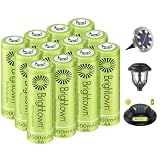
Brightown 12 Pack NiMH Rechargeable AA Batteries for Solar Lights, 2000mAh
- 【 30% Precharged for Ready Use 】 For transportation safety purposes, these batteries are only precharged with...
- 【 Rechargeable and Money-Saving 】The rechargeable AA battery can be constantly recharged 1000 times, saving you...
- 【 Reliable High Capacity 】The AA rechargeable battery was built with a 2000mAh high capacity rating that...
- 【 Multiple Daily Uses 】Can be widely used for battery string lights, toys, TV remotes, flashlights, wireless...
- 【 Solar and Standard Charging 】These rechargeable NiMH batteries can be charged via solar or standard charging...
Brightown 12 Pack NiMH Rechargeable AA Batteries offer a reliable power solution for your solar lights and other electronic devices. With a 2000mAh capacity, these batteries extend the runtime of your solar lights, so you spend less time worrying about replacements.
They arrive precharged to 30%, so a full charge is needed before first use to get the best performance. Thanks to their NiMH chemistry, they hold capacity better than older battery types, delivering consistent power every time.
Designed to be recharged up to 1000 times, these batteries help reduce waste and save money over disposables. They work with solar, standard, and fast chargers, but using a fast charger ensures a quicker power restoration.
To maintain their lifespan, it’s important to recharge them every three months. Besides solar lights, they are also great for remotes, toys, and everyday electronics that require AA batteries.
Best for: Environmentally conscious users needing long-lasting, rechargeable AA batteries for solar lighting and daily devices.
What We Like:
- High 2000mAh capacity for longer device runtime
- Rechargeable up to 1000 cycles, reducing waste
- Compatible with various chargers including solar and fast charging
- Consistent performance with NiMH chemistry
- Suitable for a wide range of electronic devices
Specification:
| Feature | Details |
|---|---|
| Manufacturer | Brightown |
| Battery Type | NiMH Rechargeable AA |
| Capacity | 2000mAh |
| Pack Size | 12 Batteries |
| Precharged | 30% |
| Recharge Cycles | Up to 1000 |
Solar Power Bank 20000mAh with 4 Panels and Build-in 3 Cables
- 【20000mAh Large Capacity】Equipped with a high-capacity 20000mAh lithium-polymer battery, this solar power bank...
- 【Charge 5 Devices Simultaneously】Supports charging up to 5 devices at once. Comes with 3 built-in cables: USB-C...
- 【4-Panel Solar Charging】Features 4 integrated high-efficiency solar panels, capturing significantly more...
- 【2 Lighting System】Includes a dual flashlight with Steady, SOS, and Strobe modes—perfect for emergencies or...
- 【IP67 Weatherproof & Intelligent Safety System】With its IP67 rating, this power bank is fully waterproof...
Reliable power is essential during long outdoor trips or unexpected emergencies. The Solar Power Bank 20000mAh meets this need with its high-capacity lithium-polymer battery. It can charge an iPhone 17 over four times and an iPad Pro once or twice, keeping your devices ready when you need them most.
Designed for convenience, this power bank supports charging up to five devices at once. It features built-in USB-C, Lightning, and USB-A cables, along with extra ports. The four integrated solar panels enhance sunlight absorption, allowing for efficient outdoor recharging when electrical outlets aren’t available.
Durability is a key benefit, with an IP67 rating that makes the device waterproof, dustproof, and shockproof. The dual flashlight and adjustable camping light add practical safety features for nighttime use, although they cannot be operated simultaneously. Solar charging depends on sunlight strength and may be slower compared to traditional methods.
To maintain optimal performance, keep the solar panels clean and avoid prolonged exposure to extreme conditions. This power bank is designed for reliable use in rugged environments, making it a practical companion for outdoor enthusiasts.
Best for: Outdoor enthusiasts and travelers who need a durable, high-capacity power bank with versatile charging options and emergency lighting features.
What We Like:
- Large 20000mAh capacity for multiple full charges
- Four solar panels for effective outdoor recharging
- IP67 rating ensures resistance to water, dust, and shock
- Integrated cables reduce the need to carry extra cords
- Dual lighting options improve safety during nighttime use
Specification:
| Feature | Details |
|---|---|
| Manufacturer | Not specified |
| Battery Capacity | 20000mAh |
| Charging Ports | USB-C, Lightning, USB-A |
| Solar Panels | 4 integrated panels |
| Durability Rating | IP67 (waterproof, dustproof, shockproof) |
| Lighting | Dual flashlight and adjustable camping light |
| Dimensions | Not specified |
| Weight | Not specified |
Factors to Consider When Choosing a Battery for Solar Charging
When choosing a battery for solar charging, you need to focus on capacity, rechargeability, and lifespan to guarantee reliable power storage. Make sure the battery is compatible with your solar panels and can handle local temperature and weather conditions.
Also, consider how fast and efficiently it charges to get the most out of your solar setup. It’s all about finding the right balance to keep your system running smoothly.
Battery Capacity Importance
Understanding battery capacity is essential for optimizing your solar charging system’s performance. Capacity, measured in ampere-hours (Ah), indicates how long a battery can power your devices.
To choose the right size, convert your daily energy needs from watt-hours to amp-hours by dividing by battery voltage (e.g., Wh ÷ 12V = Ah). Then, add a safety margin for cloudy days.
Larger capacity batteries store more energy for overnight or multi-day use but need longer solar input to recharge. Keep in mind, lead-acid batteries only allow about 50% depth-of-discharge.
On the other hand, lithium types offer 80–90% usable capacity, which is pretty efficient. Also, factor in 10–20% extra capacity to cover charging inefficiencies, temperature effects, and battery management system overheads.
This way, you ensure reliable energy availability when you need it most.
Rechargeability And Lifespan
Selecting batteries with excellent rechargeability and long lifespan plays a crucial role in maximizing your solar charging system’s efficiency and reliability.
You should pick batteries with high cycle life ratings—500 to 1000+ charge cycles for NiMH or Li-ion—to guarantee long-term use. Opt for low self-discharge chemistries or cells with LSD technology that keep at least 80% capacity after months without charging.
Match the battery chemistry and depth-of-discharge (DoD) to your solar system’s charging pattern. Li-ion handles deeper discharges better, while other chemistries may need shallower cycles to last longer.
Also, consider the recommended charging currents (C-rate) so your system charges safely without stressing cells. Finally, choose batteries with good temperature tolerance to maintain capacity despite outdoor temperature swings.
Compatibility With Solar Panels
How do you make sure your battery works seamlessly with your solar panels? Start by matching the battery chemistry with the solar panel’s output. For instance, NiMH batteries need controlled low-current charging, while Li-ion types require precise voltage regulation and a compatible charge controller.
Next, confirm that your solar panel’s voltage and current fit the battery’s charging input range—like 12–14.6V for a 12V lead-acid or LiFePO4 battery. Size your solar panel and charge controller to provide an appropriate charging current, usually around 0.1C to 0.3C of the battery’s capacity.
Choose the right charge controller type—MPPT is best when panel voltage exceeds battery voltage or for higher efficiency. Finally, check connectors, polarity, and any built-in protections to guarantee safe, reliable charging.
Temperature And Weather Resistance
After ensuring your battery matches your solar panel’s output and charge controller, the next step is to take into account how temperature and weather conditions will affect your battery’s performance and lifespan. Choose chemistries rated for your area’s ambient temperature range—NiMH and Li-ion batteries typically operate between -20°C and +60°C.
However, Li-ion performance drops below 0°C and can sustain damage if charged in freezing conditions without cold-charge protection. Look for sealed, corrosion-resistant batteries with proper venting to withstand humidity, rain, and temperature swings.
Also, verify manufacturer specs for thermal protection and operating limits. It’s a good idea to prefer packs with built-in temperature sensors or a BMS to prevent unsafe charging or discharging.
For outdoor setups, select batteries and enclosures that tolerate wide temperature swings and UV exposure. And don’t forget to consider insulation or active climate control if needed.
Charging Speed And Efficiency
Maximizing your solar charging setup means understanding how battery chemistry, voltage, and charge controller work together to influence charging speed and efficiency.
Match your battery’s chemistry and voltage to the solar panel and charge controller—Li-ion cells need precise MPPT or CC-CV control at about 3.6–3.7V per cell, while NiMH cells charge at 1.2V per cell and use different termination methods.
Faster charging demands higher input current and a capable MPPT controller, which boosts efficiency by 20–40% over PWM under varying sunlight.
Follow the battery’s recommended charge current (C-rate); charging at 0.5C–1C balances speed and longevity.
Remember, solar charging speed depends on panel wattage, sunlight, and battery voltage.
Also, temperature affects charging acceptance and may require adjustments to avoid damage.
Safety And Protection Features
Because solar charging involves variable conditions like sunlight intensity and temperature, choosing batteries with robust safety and protection features is essential. You should pick batteries with built-in protection circuitry or pair them with a battery management system (BMS) that guards against over-charge, over-discharge, over-current, short circuits, and thermal issues to prevent fire, swelling, and capacity loss.
Make certain the battery chemistry supports temperature tolerance specs, including thermal cutoffs that stop charging if it gets too hot. Also, verify the BMS matches your solar setup’s voltage and current limits to avoid overvoltage or excessive charging.
Look for features like automatic cooling, pressure-relief vents, and leak protection to reduce risks during prolonged charging. And don’t forget to confirm proper storage safeguards to prevent deep discharge or irreversible damage when solar input is intermittent.
Frequently Asked Questions
How Do Temperature Fluctuations Affect Solar Battery Performance?
You’ll notice temperature fluctuations affect your solar battery’s efficiency and lifespan; extreme heat speeds up degradation, while cold reduces capacity.
What Is the Environmental Impact of Disposing Solar Batteries?
You’ll harm the environment if you dispose of solar batteries improperly, releasing toxic chemicals and heavy metals. Always recycle them at designated centers to reduce pollution and recover valuable materials.
This way, you’re helping protect ecosystems and conserve resources. It’s a simple step that makes a big difference!
Can Solar Batteries Be Recycled Effectively?
Yes, you can recycle solar batteries effectively—but it’s not always simple. You’ll need specialized facilities to recover valuable materials safely.
When you recycle properly, you help reduce waste and protect the environment for the future. It’s definitely worth the effort!
How Long Do Solar Batteries Typically Last in Real-World Use?
You can expect solar batteries to last about 5 to 15 years, depending on the type and usage. Proper maintenance and avoiding deep discharges will help you get the most life out of your battery.
Taking good care of your battery really makes a difference. So, try to keep it in good shape, and it’ll serve you well for a long time.
Are There Any Safety Risks Associated With Solar Battery Storage?
Yes, you do face safety risks with solar battery storage, like overheating, fire, or chemical leaks. But if you follow manufacturer guidelines, install proper ventilation, and maintain your system, you’ll minimize those risks effectively.
It’s really about being careful and staying on top of things. Just a little attention goes a long way in keeping your system safe and running smoothly.
Conclusion
Choosing the right battery for solar charging isn’t just about power—it’s about freedom versus limitation. While a Portable Solar Generator offers robust energy for your adventures, smaller AA rechargeable batteries bring convenience and affordability.
A Solar Power Bank balances portability with capacity. You’ll find that the best choice depends on your lifestyle, but remember: what seems like a simple power source can either tether you to the grid or set you truly free in the sun’s embrace.
When picking the best batteries for solar charging in 2027, think about your needs first. Do you want something lightweight and easy to carry, or do you need a powerhouse for longer trips? The right battery can make all the difference in your solar setup, giving you reliable energy wherever you go.
So, whether it’s a Portable Solar Generator, AA rechargeable batteries, or a Solar Power Bank, choosing the right solar battery is key to enjoying clean, renewable energy without limits.