1 Best App to See the Solar System in 2027
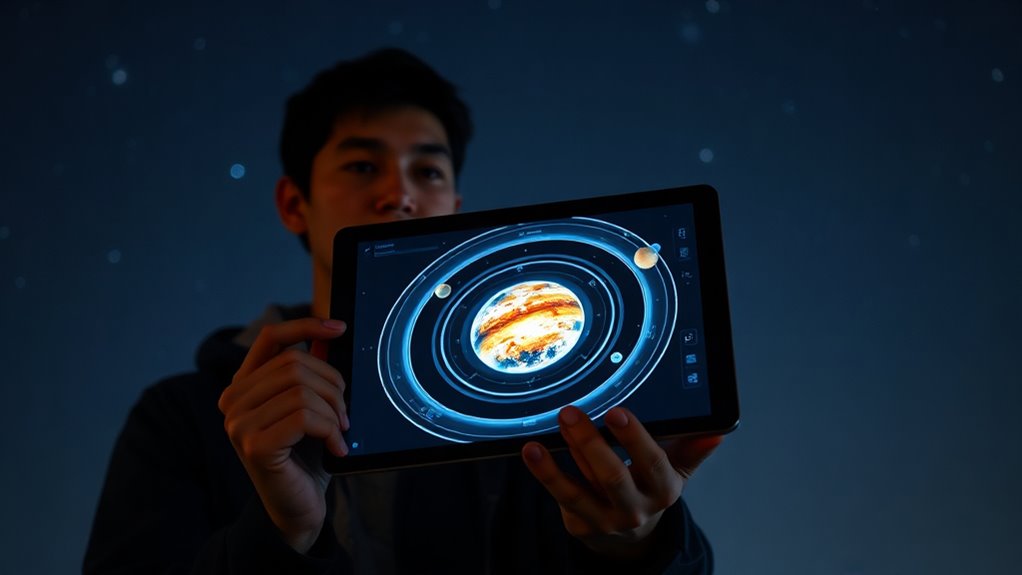
For the best solar system experience in 2027, you’ll want Solar System AR by myARgalaxy. This app brings the solar system to life right on your phone, transforming flat cards into vivid 3D planetary models with immersive AR. It’s perfect if you love exploring space in a fun and interactive way.
The app works smoothly on both Android and iOS, offering high-quality visuals that make each planet feel real. Plus, it provides educational depth that’s great for students and space fans alike.
Curious about how it handles updates, offline use, and cost? Keep reading, and I’ll fill you in on all the details!
| Image | Name | Editor's Rating | Price |
|---|---|---|---|

|
|
Solar System AR – myARgalaxy Augmented Reality Cards
- Augmented Reality Cards for Mobile Devices (Android & iOS)
- 10 AR Cards of the Solar System: The Sun, Mercury, Venus, Earth, Mars, Jupiter, Saturn, Uranus, Neptune, and Pluto
- Collectible Cards
- Learn About the Solar System
- Interactive Fun with Friends & Family
Bring the solar system right to your fingertips with Solar System AR – myARgalaxy Augmented Reality Cards. This innovative set transforms flat cards into vivid 3D planetary models on your mobile device, making space exploration accessible and engaging. It solves the challenge of visualizing celestial bodies by offering an interactive, hands-on learning experience.
Each card triggers detailed AR visuals that reveal essential facts about planets and the Sun. The intuitive design allows users to explore planetary positions and unique traits effortlessly. Simply launch the app on your Android or iOS device and point your camera at a card to dive into a captivating space adventure.
Maintenance is minimal—just keep the cards clean and store them safely to avoid damage. The AR app requires periodic updates to ensure smooth performance, so regular device maintenance is advised. While the 10-card set provides a focused introduction, it may not satisfy users seeking deeper content.
This product is ideal for students, educators, and space enthusiasts who want a practical and interactive tool to enhance their understanding of the solar system through mobile augmented reality.
Best for: Students and educators seeking an interactive AR experience to explore planetary science in a hands-on way.
What We Like:
- Immersive 3D AR visuals enhance comprehension and engagement
- Covers key planetary facts and unique features clearly
- Compatible with both Android and iOS devices for broad accessibility
- Easy to maintain with simple care for cards and app updates
Specification:
| Feature | Details |
|---|---|
| Manufacturer | myARgalaxy |
| Dimensions | Standard card size (~3.5 x 2.5 in / 8.9 x 6.4 cm) |
| Weight | Lightweight, approximately 10 g per card |
| Material | Durable cardstock |
| Color Options | Full-color printed cards |
Factors to Consider When Choosing App to See Solar System
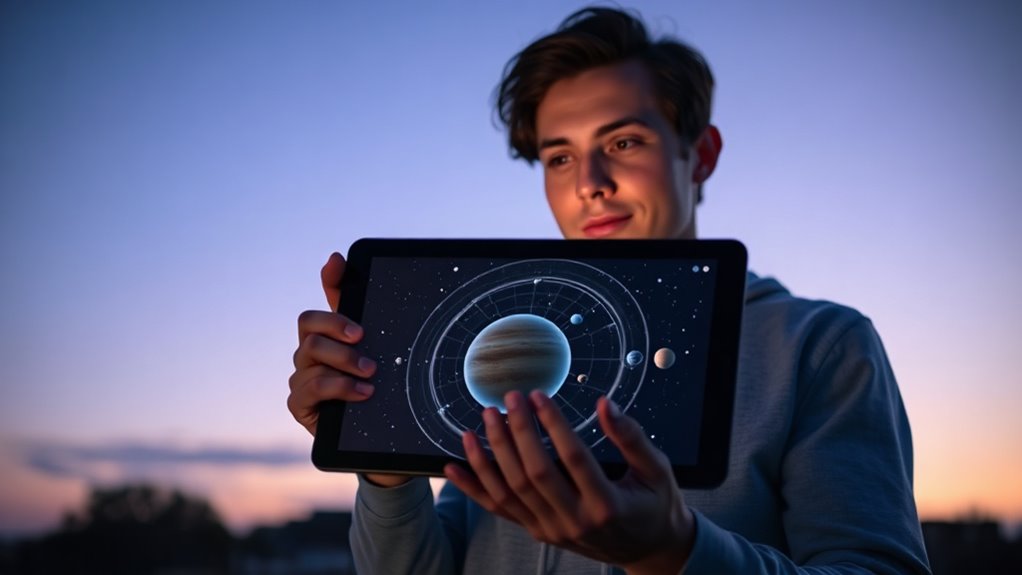
When choosing an app to explore the solar system, you’ll want to check if it works smoothly on your device and offers an intuitive interface.
Pay attention to how detailed the educational content is and whether the app lets you interact with the planets.
Also, consider the quality of the visuals to make your experience as realistic as possible.
Device Compatibility
Although many solar system apps offer incredible features, you’ll need to make sure your device meets specific compatibility requirements to enjoy them fully. First, verify your device’s operating system—most apps need Android 8.0+ or iOS 13+ to function properly.
Then, check for essential hardware like ARCore or ARKit support and a gyroscope to enable augmented reality and smooth 3D navigation. Your CPU, GPU, and RAM matter too; aim for mid-to-high-range processors and at least 2–3 GB of free memory to handle detailed models and real-time rendering.
Don’t forget storage—downloaded textures and offline data can take significant space. Finally, consider battery life and thermal management since intensive graphics and AR features can quickly drain power and reduce performance during extended use.
User Interface Design
Choosing a solar system app often hinges on how well its user interface supports your exploration. You want a clear, uncluttered layout that highlights the solar system view with readable labels and consistent icons. This way, you can quickly find orbit controls, time sliders, and info panels.
Responsive touch and gesture controls—like pinch-to-zoom, two-finger rotate, and swipe to pan—should work smoothly with minimal lag. That makes navigation on phones and tablets feel intuitive and natural.
Accessing contextual information without leaving the main view is key. Tooltips or expandable cards keep you immersed while offering planet facts and scale indicators.
Look for adjustable visual settings and accessibility modes to tailor the experience just for you. Finally, apps with clear onboarding, hints, and easy-to-find help menus reduce the learning curve and keep you engaged.
Educational Content Depth
A well-designed interface sets the stage, but the true value of a solar system app lies in the depth of its educational content. You want an app that offers multi-level explanations tailored to your knowledge, whether you’re a beginner or advanced learner.
It should provide accurate, current facts like planet sizes, compositions, and orbital details in familiar units such as kilometers or astronomical units. Look for apps that go beyond surface-level visuals to cover core concepts like gravity, atmospheric makeup, and orbital mechanics.
Quizzes or lessons with progress tracking help reinforce what you’ve learned. And finally, make sure the app cites trusted sources, such as space agencies or peer-reviewed studies, so you can trust the information and deepen your understanding confidently.
Interactive Features Availability
When exploring the solar system through an app, interactive features can transform your experience from passive observation to active discovery. You’ll want an app that offers interactive 3D models you can rotate, zoom, and pan to examine planets and their spatial relationships closely.
Being able to toggle data layers like orbits, names, atmospheres, and moons lets you customize your view to focus on what interests you most. Time controls are essential, too, allowing you to play, fast-forward, rewind, or input specific dates to see orbital motions and historical positions.
Apps with guided tours, quizzes, or narrated overlays enhance learning as you interact. And if you’re interested in shared exploration or augmented reality, look for multi-user or AR interaction options for a more immersive experience.
Visual Realism Quality
Interactive features can enhance your exploration, but the visual realism of the app really shapes how immersive that experience feels. You should check for high-resolution textures like 4K assets that reveal surface details—craters, cloud bands, and rings—with sharp clarity.
Look for physically based rendering and realistic lighting models simulating sunlight, shadows, and atmospheric effects to create lifelike planets and moons. Confirm if the app uses scale-accurate sizes and distances or allows toggling between true scale and zoomed views. Realistic proportions really deepen immersion.
Pay attention to smooth, accurate animations reflecting rotation, tilt, and orbital motion, which bring the system to life. Finally, make sure the app supports quality post-processing effects such as bloom and HDR while offering adjustable graphics settings to balance realism and performance.
Offline Accessibility Options
Considering offline accessibility is essential if you want to explore the solar system without relying on an internet connection. First, confirm whether the app offers a fully offline mode that stores 3D models, textures, and informational text locally.
Keep in mind that detailed planetary models and textures can take up hundreds of megabytes or even several gigabytes of space. Look for apps with offline maps, timelines, and search features so you can navigate planetary positions and facts without network access.
Also, check if AR features need online resources. Many rely on cloud anchors or streaming assets and might not work offline.
Finally, find out how offline content updates are handled. See if you can download updates for offline use, so your data stays current without internet access.
Update Frequency
You should regularly check an app’s update frequency to guarantee it delivers accurate astronomical data and smooth performance. Apps updated every 3 to 6 months tend to include the latest planetary positions, bug fixes, and compatibility patches.
Frequent updates also show active developer support, which is vital for adapting to new device OS versions and AR libraries. This helps minimize crashes or lag on your smartphone or tablet.
Look for apps that sync updates with major astronomical events or provide automatic content refreshes. That way, you don’t have to manually update imagery or star catalogs.
Avoid apps that haven’t been updated in over a year; they might lack recent security patches, AR compatibility, and corrected scientific data. Using those could compromise your learning experience and app reliability.
Cost and Licensing
Although many solar system apps offer free versions, you’ll want to examine their cost structures carefully because ongoing subscriptions or in-app purchases can add up quickly. Check if the app is free, freemium, or requires upfront payment. Subscriptions may range from a few dollars to $20 monthly for premium features.
Confirm the license terms to see if the app allows personal, educational, or commercial use. Keep in mind, some educational licenses restrict classroom use or need volume licensing.
Look for trial periods or refund policies to test AR compatibility and content quality without risk. Also, verify device or account licensing limits to match your usage needs.
Finally, see if updates and new features are included or sold separately to avoid unexpected costs. It’s always good to know exactly what you’re signing up for!
Frequently Asked Questions
Can I View the Solar System Offline With These Apps?
Yes, you can view the solar system offline with many astronomy apps. They download data beforehand, letting you explore planets and stars without internet.
Just make sure to sync your app while you’re online first. That way, everything’s ready when you want to use it offline.
Are These Apps Compatible With Both iOS and Android Devices?
Isn’t it great when apps work everywhere? Yes, these apps are compatible with both iOS and Android devices.
Do Any Apps Offer Real-Time Planetary Positions for 2027?
Yes, you’ll find apps like Stellarium and SkySafari that offer real-time planetary positions for 2027. They update dynamically, so you can explore accurate celestial events whenever you want, right on your device.
These apps make stargazing super easy and fun. Just open them up, and you’re ready to dive into the cosmos anytime!
Can I Use These Apps to Learn About Moons and Asteroids?
You can definitely use these apps to learn about moons and asteroids!
For example, Jupiter has 79 known moons, and many apps let you explore their orbits, sizes, and even surface features interactively.
It’s pretty cool to see all that info right at your fingertips. Plus, you get to learn in a fun, hands-on way!
Are There Apps That Include Space Mission Tracking Features?
Yes, you’ll find apps like SkyView and Heavens-Above that include space mission tracking features. They let you follow satellites, spacecraft, and missions in real-time, giving you an interactive way to explore ongoing space activities.
It’s pretty cool because you get to see what’s happening up there right now. Plus, these apps make space feel a bit closer and more exciting to explore.
Conclusion
When choosing the best app to see the solar system in 2027, you want seamless device compatibility, an intuitive user interface, and rich educational content. You want vivid visual realism, offline accessibility, and regular updates.
Transparent costs and flexible licensing are important too. Solar System AR – myARgalaxy Augmented Reality Cards delivers all that and more.
So, explore confidently, learn deeply, and experience the cosmos vividly with the app designed just for you. If you’re looking for an app to see the solar system in 2027, this one combines stunning visuals, easy navigation, and educational value perfectly. It’s a top choice for anyone curious about space, whether a beginner or an enthusiast.