3 Best Batteries for a 100W Solar Panel in 2027
For a 100W solar panel in 2027, choosing the right battery is all about balancing capacity, durability, and compatibility. You want something that can store enough power, last a long time, and work smoothly with your solar setup. Picking the best battery can really boost your solar panel’s efficiency and keep your energy flowing when the sun isn’t shining.
The 100W 12V Solar Power Kit comes with a 20Ah LiFePO4 battery. It’s lightweight and offers a long lifespan, making it a solid choice for many users.
Then there’s the ExpertPower kit, which features a 21Ah gel deep-cycle battery. It’s great for steady, reliable performance over time.
If you’re after high capacity, the Mighty Max 12V 100Ah AGM battery is ideal for heavy use and larger energy demands. Keep exploring to uncover key factors that could refine your pick.
| Image | Name | Editor's Rating | Price |
|---|---|---|---|

|
|
||

|
|
100W 12V Solar Power Kit with LiFePO4 Battery
- ECI Power: A brand for everyone with the goal of providing an open avenue for all to know that safe lithium power...
- This Off-Grid Solar System Kit includes one 12V 20Ah LiFePO4 Battery, one 100W Monocrystalline Solar Panel and one...
- Economical: At a phenomenal price point, the battery is rigorously lab-tested and guaranteed to meet a minimum...
- System Detect: The 10A PWM controller automatically recognizes 12V and 24V systems for quick setup and programmed...
- Smart Tech: The controller automatically regulates charging profiles relative to ambient temperatures, providing...
Experience reliable and efficient solar power wherever your adventures take you with the 100W 12V Solar Power Kit featuring a durable LiFePO4 battery. This kit is designed to provide consistent energy for RVs, campers, trailers, and off-grid projects, helping you stay powered without the hassle of frequent battery replacements.
The included 20Ah lithium iron phosphate battery supports thousands of charge cycles, ensuring a long-lasting power source that reduces maintenance needs. Its smart 10A PWM charge controller adjusts charging based on temperature, protecting the battery and extending its lifespan.
Compact and versatile, this kit supports both 12V and 24V systems, making it adaptable for various setups. With the included cables and mounting brackets, installation is straightforward, letting you focus on your outdoor activities without worrying about complicated setups.
While the 100W panel is ideal for moderate power demands, it may not suit larger systems or heavy usage. The PWM controller provides reliable charging but is less efficient than MPPT controllers under some conditions. Battery capacity is sufficient for typical off-grid use but may require additional storage for extended periods.
Best for: outdoor enthusiasts and off-grid adventurers needing a dependable, easy-to-maintain solar power solution for compact mobile or stationary setups.
What We Like:
- Long-lasting 20Ah LiFePO4 battery with up to 5,000 charge cycles
- Smart 10A PWM controller with temperature compensation for battery protection
- Compatible with both 12V and 24V systems for flexible use
- Complete kit with mounting brackets and cables for easy installation
Specification:
| Feature | Details |
|---|---|
| Manufacturer | ECI Power |
| Solar Panel Power | 100W |
| Battery Type | LiFePO4 (Lithium Iron Phosphate) |
| Battery Capacity | 20Ah |
| Charge Controller | 10A PWM, temperature compensated |
| System Voltage Support | 12V / 24V |
| Included Accessories | Cables, mounting brackets |
| Weight | Not specified |
ExpertPower 100W 12V Solar Power Kit with Battery
- Package includes one 100W Solar Panel and one 10A PWM Solar Charge Controller, one 12v21Ah Gel Deep Cycle battery...
- ExpertPower 100 Watt Monocrystalline solar panel contains highly efficient monocrystalline solar cells protected by...
- This 10A PWM controller is suitable for 12/24V lead -acid batteries, ternary lithium batteries and lithium iron...
The ExpertPower 100W 12V Solar Power Kit with Battery offers a reliable energy solution for those needing consistent power in remote or off-grid locations. Its durable monocrystalline panel is designed to withstand harsh weather, ensuring long-lasting performance without frequent maintenance. This kit simplifies power generation by combining a solar panel, battery, and charge controller into one ready-to-use system.
The included 12V 21Ah gel deep-cycle battery provides steady energy storage, ideal for backup or small-scale power needs. Its compatibility with both lead-acid and lithium batteries gives users flexibility in choosing the best storage option. The 10A PWM charge controller efficiently manages energy flow to protect the battery and extend its lifespan.
Setup is straightforward with all necessary cables and mounting brackets included, making it suitable for semi-permanent installations. Weighing just 14.6 pounds, the system is portable yet robust enough for consistent off-grid use. While the 100W panel limits high power output, it remains a solid choice for basic energy needs.
Best for: Users seeking a dependable and easy-to-install 12V solar power system with integrated battery and controller for off-grid or emergency power applications.
What We Like:
- Complete system including panel, battery, controller, cables, and mounts
- Weather-resistant design with tempered glass and aluminum frame
- Supports multiple battery chemistries for flexible energy storage
- Lightweight and portable for semi-permanent setups
Specification:
| Feature | Details |
|---|---|
| Manufacturer | ExpertPower |
| Solar Panel Power | 100 Watts |
| System Voltage | 12 Volts |
| Battery Type | 21Ah Gel Deep-Cycle |
| Charge Controller | 10A PWM |
| Panel Frame Material | Corrosion-resistant Aluminum |
| Panel Glass | Tempered Glass |
| Weight | 14.6 lb (6.6 kg) |
Mighty Max 12V 100AH Deep Cycle Battery
No products found.
The Mighty Max 12V 100AH Deep Cycle Battery delivers consistent power for those who need a trustworthy energy source without the hassle of frequent maintenance. Its sealed lead acid AGM design ensures a spill-proof and vibration-resistant build, letting you install it in virtually any position without worry. This feature is especially useful in mobile or rugged environments.
Designed for versatility, this battery supports 12V systems on its own and can be connected with others to power 24V or 48V setups. It excels in storing energy efficiently for solar power systems, making it a dependable partner for off-grid applications. The battery performs well in various temperatures, ensuring reliable power throughout the year.
The maintenance-free nature of this battery saves time and effort, eliminating the need for water refills or regular checks. Its robust construction resists shocks and vibrations, adding to its long service life. However, it comes only with screws, so additional mounting accessories or wiring need to be sourced separately.
While it offers solid performance, the battery is relatively heavy and large, which might limit its portability. Its one-year warranty is shorter than some competing models but reflects its straightforward design and focused use.
Best for: Homeowners and solar enthusiasts seeking a durable, maintenance-free deep cycle battery for reliable 12V energy storage.
What We Like:
- Spill-proof AGM design allows flexible mounting options
- Compatible with multiple voltage solar setups by linking batteries
- Strong resistance to shocks and vibrations for long-term durability
- Performs well across a wide temperature range
- Maintenance-free operation reduces upkeep time
Specification:
| Feature | Details |
|---|---|
| Manufacturer | Mighty Max |
| Voltage | 12V |
| Capacity | 100AH |
| Battery Type | Sealed Lead Acid AGM |
| Dimensions | Not specified |
| Weight | Not specified |
| Design | Spill-proof, vibration resistant |
Factors to Consider When Choosing a Battery for a 100W Solar Panel
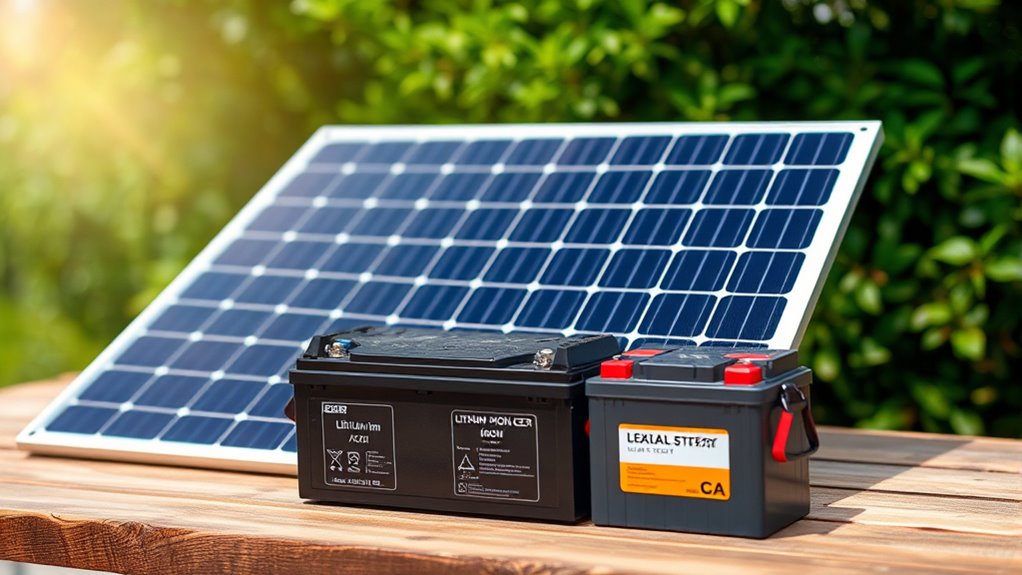
When choosing a battery for your 100W solar panel, you’ll need to take into account capacity, chemistry, and how long it lasts through charge cycles.
Make sure the battery charges well with your solar setup and fits your maintenance preferences. These factors will help you get the best performance and value from your system.
Picking the right battery might seem tricky at first, but once you know what to look for, it gets a lot easier. Just keep these points in mind, and you’ll be set!
Battery Capacity Needs
To accurately size your battery for a 100W solar panel, start by estimating daily energy production based on peak sun hours—typically around four hours for many locations. That gives you roughly 400 watt-hours per day.
Next, convert this to amp-hours by dividing by your system voltage (for 12V, that’s about 33 Ah). Remember to factor in depth of discharge (DoD); if your battery’s DoD is 50%, you’ll need to double the usable capacity to protect battery life.
Also, add 10–30% more capacity to cover system inefficiencies like charging losses. If you want backup power for multiple days, just multiply your daily energy needs by the number of autonomy days before converting.
This method guarantees your battery can reliably store enough energy to meet your solar setup’s demands. Easy, right?
Battery Chemistry Types
Choosing the right battery chemistry is crucial for maximizing the efficiency and lifespan of your 100W solar panel system. Lead-acid batteries—flooded, AGM, or gel—are budget-friendly but offer shorter cycle life (300–1,000 cycles) and need larger capacity to avoid deep discharges.
Lithium iron phosphate (LiFePO4) batteries cost more upfront but last longer (2,000–5,000+ cycles), allow deeper discharge (80–100% DoD), and weigh less. Nickel-based types like NiMH and NiCd aren’t ideal for small solar setups due to lower energy density and environmental concerns.
Also, consider charge algorithms: LiFePO4 requires specific CC-CV profiles and temperature compensation for safety and longevity. Self-discharge varies too—lead-acid loses charge faster and struggles in cold, while LiFePO4 handles temperature swings better with low self-discharge.
Choose chemistry that fits your budget, usage, and climate. It really makes a difference in getting the most out of your system.
Cycle Life Expectancy
Battery chemistry sets the stage for how long your 100W solar panel’s battery will perform reliably, but understanding cycle life expectancy lets you gauge its real-world longevity. Cycle life refers to the number of full charge–discharge cycles a battery can endure before its capacity drops to about 80%.
For example, lead-acid AGM batteries might last a few hundred cycles, while LiFePO4 batteries can offer 2,000 to 5,000 cycles depending on use. Depth of discharge (DoD) plays a big role—cycling at 50% DoD extends life compared to deeper discharges.
Also, high temperatures and poor charge management reduce cycle life. To estimate your battery’s lifespan, calculate daily energy use against usable capacity, then multiply by the expected cycles at your typical DoD. This helps you plan for years of reliable power.
Charging Compatibility
Match your battery and solar panel carefully to guarantee efficient charging and system safety. First, assure your battery’s nominal voltage aligns with your 100W panel’s system voltage—typically 12V. A mismatch disrupts charging.
Next, check that your charge controller supports your battery chemistry, whether LiFePO4, AGM, or lead-acid, and offers the correct charging profile like CC-CV or multi-stage charging. Also, verify the controller’s amperage rating exceeds your panel’s output—since a 100W panel at around 18V generates about 5–6 amps, a 10A controller provides necessary headroom.
Don’t forget to confirm the battery’s recommended charge current (C-rate) matches the panel and controller’s supply capacity, usually between 0.2C and 0.5C. Finally, assure temperature compensation features prevent improper charging under varying ambient conditions.
Maintenance Requirements
Regularly inspecting your battery’s terminals and connections is essential to keeping your 100W solar setup running smoothly. Check for corrosion and make certain tight connections monthly. If needed, clean terminals with a 50/50 baking soda and water solution.
If you use flooded lead-acid batteries, monitor electrolyte levels every 1–3 months. After charging, top off with distilled water to avoid plate exposure.
Keep an eye on your battery’s state of charge weekly. Try to avoid storing lead-acid batteries below 50% SOC and lithium batteries below 20–30% SOC to prevent capacity loss.
Equalize flooded lead-acid batteries periodically to balance cells. But don’t worry, this isn’t necessary for AGM or lithium types.
Finally, store batteries in temperature-controlled environments. Perform capacity checks annually to maintain their lifespan and performance.
Physical Size Constraints
When selecting a power storage solution for your 100W solar panel, you’ll need to take into account the physical size constraints carefully. Make sure the battery’s dimensions and weight fit your installation space, leaving enough clearance for ventilation and cable routing.
Also, consider mounting orientation and hardware space since some batteries require specific positioning for secure attachment. It’s a good idea to leave extra room around terminals so you can easily connect or disconnect 12AWG–2/0 gauge cables without bending or stretching.
Don’t forget to verify your enclosure or vehicle location supports the battery’s thermal needs. Proper airflow is important to maintain recommended operating temperatures.
If you plan to use multiple batteries, factor in their combined footprint and spacing for series or parallel connections. Make sure there’s enough room for busbars and safety disconnects to keep everything organized and accessible.
Budget and Warranty
Although upfront cost often grabs your attention first, you should focus on the cost per usable capacity to get a clearer picture of long-term value. Batteries with higher cycle life or LiFePO4 chemistry may cost more initially but often save money over time due to longer lifespan and deeper discharge capabilities.
Check warranty length and coverage closely—look for explicit cycle life guarantees, like 2,000+ cycles at 80% depth of discharge. Also, understand what voids it, such as improper charging or extreme temperatures.
Budget for replacements and maintenance, especially with non-sealed chemistries. And don’t forget to consider return policies and warranty service logistics, since who pays shipping and claim procedures affect downtime and overall cost.
Balancing these factors helps you choose a battery that fits both your budget and long-term needs. It’s all about finding the right fit for you!
Frequently Asked Questions
How Do Temperature Extremes Affect Battery Performance for Solar Panels?
Temperature extremes reduce your battery’s efficiency and lifespan. Cold slows chemical reactions, cutting capacity, while heat accelerates degradation and self-discharge.
Can These Batteries Be Used for Off-Grid Home Energy Systems?
Imagine powering your cozy cabin entirely off-grid—yes, you can use these batteries! They store energy efficiently, letting you enjoy reliable power day and night.
Even when the sun hides behind clouds or stars twinkle above, you won’t have to worry about losing electricity. Pretty cool, right?
What Is the Typical Lifespan of a Battery Used With a 100W Solar Panel?
You can expect a typical battery lifespan of 5 to 15 years, depending on the type and usage.
Lithium batteries last longer, around 10-15 years, while lead-acid batteries usually last about 5-7 years with proper care. So, it really comes down to how you use and maintain them.
Are These Batteries Safe for Indoor Use and Storage?
You won’t need a hazmat suit—these batteries are generally safe for indoor use and storage if you follow manufacturer guidelines.
Just keep them ventilated, away from heat, and avoid puncturing to prevent any explosive surprises.
How Do Charging Times Vary Between Different Battery Types?
Charging times vary because lithium batteries charge faster than lead-acid ones. You’ll find lithium types often take 2-4 hours, while lead-acid batteries can take 6-12 hours, depending on capacity and charger efficiency.
It really depends on the battery size and how good your charger is. So, if you’re in a hurry, lithium is usually the way to go! But if you’re using lead-acid, just be ready to wait a bit longer.
Conclusion
So, you’ve got your 100W solar panel—now pick a battery that won’t leave you in the dark or begging for juice like it’s a caffeine addict. Whether you go LiFePO4, ExpertPower, or Mighty Max, just remember: your battery’s job is to store energy, not to audition for a drama series.
Choose wisely, because unlike your phone, solar batteries don’t come with a “Do Not Disturb” mode when they die on you. Picking the right battery for your 100W solar panel is crucial to keep your setup running smoothly and efficiently.
In 2027, the best batteries for a 100W solar panel offer longevity, safety, and consistent performance. LiFePO4 batteries are popular for their durability and safety features. Brands like ExpertPower and Mighty Max also provide reliable options that work well with small to medium solar systems.
So, whether you want long-lasting power or budget-friendly choices, these top batteries will keep your 100W solar panel system energized and dependable for years to come.