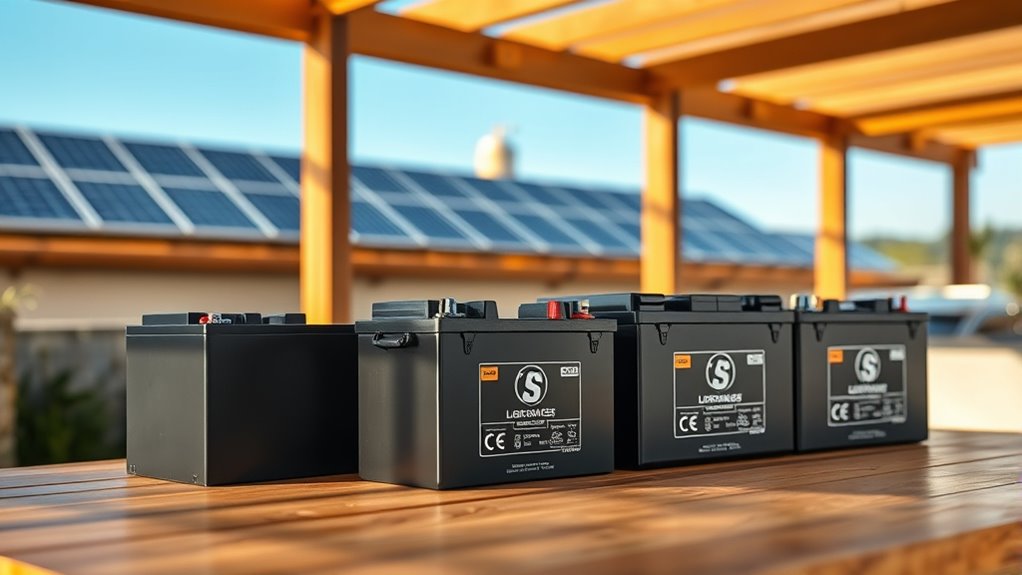
6 Best 12 Volt Batteries for Solar Panels in 2027
You’ll want a reliable 12V battery like the 100Ah LiFePO4 Group 31 for long life and lightweight design. Or, if portability is a priority, the NERMAK 12V 10Ah LiFePO4 is a great choice with solid protection built in.
Kits like the 100W LiFePO4 solar power kit and ExpertPower’s 21Ah gel battery offer complete solutions that make setting up your solar panel system easy.
For those who need something ultra-portable, the DOKIO foldable panel pairs perfectly with 12V batteries. On the other hand, Renogy’s 100Ah AGM battery provides a heavy-duty lead-acid option for more demanding setups.
Keep scanning for insights on choosing the right battery for your solar setup, so you get the best performance and value for your investment.
12V 100Ah LiFePO4 Battery Group 31 Deep Cycle Lithium Battery for RV Marine
The 12V 100Ah LiFePO4 Battery Group 31 offers a reliable power solution for RVs, marine vessels, and off-grid solar systems. Its lightweight design reduces the burden on your setup while delivering consistent energy. At just 24 pounds, it weighs about 60% less than traditional lead-acid batteries, making transport and installation easier.
This deep cycle battery provides 1280 Wh of usable power at 12.8 volts, ensuring long-lasting performance. Its built-in Battery Management System safeguards against overcharge, over-discharge, and short circuits. This protection helps extend the battery’s lifespan and reliability in various conditions.
Designed for durability, the battery features an IP65 rating, which means it resists dust and water ingress. It performs well in harsh environments, making it suitable for mobile power needs and solar energy storage. You can also increase capacity by connecting up to four batteries in parallel or series.
Maintenance is minimal since the battery is fully sealed and does not require watering or equalizing. However, a compatible LiFePO4 charger or solar controller is necessary to ensure optimal charging and prolong battery life.
Best for: Users needing a lightweight, durable, and maintenance-free 12V deep cycle lithium battery for RV, marine, or off-grid solar applications.
What We Like:
- Long cycle life with up to 15,000 cycles depending on use
- Integrated Battery Management System for safety and reliability
- Lightweight and compact with IP65 rating for tough conditions
- Expandable capacity through parallel or series connections
Specification:
| Feature | Details |
|---|---|
| Manufacturer | Not specified |
| Voltage | 12.8 V |
| Capacity | 100 Ah |
| Energy | 1280 Wh |
| Weight | 24 lb (approx. 10.9 kg) |
| Battery Type | LiFePO4 (Lithium Iron Phosphate) |
| Dimensions (Group 31) | Not specified |
| Protection Rating | IP65 |
NERMAK 12V 10Ah Lithium LiFePO4 Deep Cycle Battery with 10A BMS,Lightweight
Experience reliable, lightweight power with the NERMAK 12V 10Ah LiFePO4 battery. Designed to deliver consistent energy, it solves common issues like short battery life and heavy weight in portable power sources. Its lithium iron phosphate chemistry ensures safety and longevity, making it a practical choice for various applications.
This battery features a built-in 10A Battery Management System (BMS) that protects against overcharge, over-discharge, over-current, and short circuits. These safeguards reduce maintenance needs and extend the battery’s usable life. You can rely on it for over 2,000 charge cycles, which is significantly longer than traditional lead-acid batteries.
Compact and easy to maintain, the NERMAK battery supports continuous 10A discharge and fast charging at 6A. It is ideal for small solar power systems, backup energy storage, and outdoor activities. Plus, you can connect up to four units in series or parallel to increase capacity and voltage.
While this battery excels in deep cycle use, it is not designed for motorcycle starting. It requires LiFePO4-compatible chargers for optimal performance and is limited to a 10A continuous discharge current.
Best for: Outdoor enthusiasts, small solar power users, and those needing a durable, lightweight 12V battery with built-in protection for portable and backup power.
What We Like:
- Over 2,000 charge cycles for extended lifespan
- Integrated 10A BMS ensures comprehensive safety
- Lightweight design simplifies transport and installation
- Expandable capacity by connecting multiple batteries
- Supports continuous 10A discharge and fast 6A charging
Specification:
| Specification | Details |
|---|---|
| Manufacturer | NERMAK |
| Voltage | 12V |
| Capacity | 10Ah |
| Chemistry | Lithium Iron Phosphate (LiFePO4) |
| Continuous Discharge | 10A |
| Charge Current | 6A |
| Dimensions | Not specified |
| Weight | Lightweight (exact weight not specified) |
100W 12V Solar Power Kit with LiFePO4 Battery
Experience dependable off-grid power with the 100W 12V Solar Power Kit, designed to keep you energized wherever you go. Its LiFePO4 battery offers a robust and safe energy source, ensuring your devices stay powered longer without frequent replacements. This kit solves common power challenges for mobile and remote users by providing a compact, easy-to-manage system.
The included 10A PWM charge controller uses smart CC-CV charging to extend battery life and maintain optimal performance. A clear digital display helps you monitor battery health, preventing overcharging and short circuits. This thoughtful design reduces maintenance and keeps your system reliable.
Ideal for RVs, campers, and marine applications, the kit’s compact and sturdy setup fits seamlessly into limited spaces. The monocrystalline solar panel efficiently captures sunlight, making it suitable for various outdoor environments. Its durability supports long-term use without sacrificing performance.
With up to 5,000 charge cycles at 50% depth of discharge, the battery guarantees lasting power for your adventures. While the 20Ah capacity suits moderate energy needs, high-demand users might find it limiting, and the fixed solar panel design may challenge unconventional installations.
Best for: Off-grid enthusiasts and mobile users needing a durable, smart solar power solution for moderate energy needs.
What We Like:
- Long-lasting LiFePO4 battery with up to 5,000 cycles.
- Smart 10A PWM controller with digital battery monitoring.
- Complete kit with easy installation components.
- Compact design ideal for RV, camper, and marine use.
Specification:
| Feature | Details |
|---|---|
| Manufacturer | ECI Power |
| Battery Capacity | 12V 20Ah LiFePO4 |
| Solar Panel Power | 100W Monocrystalline |
| Charge Controller | 10A PWM with CC-CV charging |
| Dimensions (Panel) | Approx. 40 x 20 inches |
| Weight (Battery) | Approx. 6.5 lbs (3 kg) |
| Kit Includes | Panel, battery, cables, mounts |
ExpertPower 100W 12V Solar Power Kit with Battery
The ExpertPower 100W 12V Solar Power Kit with Battery offers a compact and reliable solution for off-grid energy needs. It efficiently converts sunlight into usable power, helping you maintain essential devices without interruption. This kit is designed to simplify solar power use, making it accessible for everyday applications.
Its durable aluminum frame and tempered glass protect the solar panel against harsh weather, ensuring long-term performance. The included 10A PWM charge controller manages battery charging safely, extending battery life and reducing maintenance efforts. This all-in-one kit minimizes setup complexity, letting you focus on your energy needs.
The 12V 21Ah gel deep-cycle battery stores energy effectively for use during low sunlight periods. While its capacity suits small-scale power demands, it may require more frequent recharging under heavier loads. The kit’s compatibility with different battery chemistries adds versatility for future upgrades.
With a lightweight design and easy installation, this solar power kit fits well in permanent or semi-permanent setups. It balances portability with steady 12V output, making it a practical choice for remote or off-grid locations.
Best for: Individuals or small-scale users seeking a compact, reliable solar power kit for permanent or semi-permanent off-grid energy needs.
What We Like:
- Complete kit including solar panel, charge controller, battery, cables, and mounting brackets.
- Weather-resistant build with tempered glass and corrosion-resistant aluminum frame.
- Supports multiple battery types and delivers stable 12V output up to 10A.
- Lightweight design enhances portability and ease of installation.
Specification:
| Feature | Details |
|---|---|
| Manufacturer | ExpertPower |
| Solar Panel Power | 100W |
| Voltage Output | 12V |
| Battery Type | Gel deep-cycle |
| Battery Capacity | 21Ah |
| Charge Controller | 10A PWM |
| Weight | 14.6 lbs (6.6 kg) |
| Frame Material | Aluminum |
DOKIO 100W Portable Foldable Solar Panel Kit for 12V Battery Charging
Experience reliable power anywhere with the DOKIO 100W Portable Foldable Solar Panel Kit. Designed to charge 12V batteries efficiently, this kit offers a smart solution for outdoor power needs. Its high-efficiency monocrystalline cells ensure consistent energy output, helping you stay powered during your adventures.
The foldable design makes it easy to carry and set up. You can position the panel in direct sunlight while keeping the included PWM charge controller shaded, protecting your battery from overcharge and short circuits. The kit’s versatile connectors and a 9.84 ft cable provide flexible installation options.
Maintenance is simple: just keep the panel surface clean and avoid shading to maintain optimal performance. The dual USB ports add convenience by powering small devices directly, though they work best when connected to a 12V battery.
This solar panel kit is ideal for RV owners, campers, and emergency preppers who need dependable and portable energy on the go. While the maximum output suits most 12V systems, some power stations with lower input caps might limit its full potential.
Best for: Outdoor enthusiasts and emergency preppers requiring a portable, efficient solar panel kit for 12V battery charging.
What We Like:
- Efficient monocrystalline cells deliver reliable 100W power.
- PWM charge controller protects battery health.
- Flexible setup with multiple connectors and long cable.
- Dual USB ports for charging small devices.
- Compact foldable design for easy transport.
Specification:
| Feature | Details |
|---|---|
| Manufacturer | DOKIO |
| Power Output | 100W nominal |
| Voltage | 12V DC |
| Current Output | Up to 6.1A |
| Dimensions (folded) | Approx. (not specified) |
| Weight | Approx. (not specified) |
| Cable Length | 9.84 ft (3 meters) |
| Connectors | SAE, XT60, DC, Alligator clips |
| Charge Controller | PWM |
Renogy 12 Volt 100Ah Deep Cycle AGM Battery, Lead Acid Solar Battery
Experience dependable energy with the Renogy 12 Volt 100Ah Deep Cycle AGM Battery, designed to keep your off-grid and RV power systems running smoothly. This battery’s maintenance-free sealed AGM design enhances safety and chemical stability, so you can focus on your activities without frequent upkeep.
Its 100Ah capacity and 12V output provide steady power for appliances like refrigerators, microwaves, and laptops. The battery’s ability to connect in series or parallel offers versatility, making it adaptable to various solar and power configurations.
Built to perform in temperatures from -4 to 140°F, this battery handles diverse environments reliably. It also features a low self-discharge rate, losing less than 3% capacity monthly at room temperature, ensuring it’s ready when you need it.
While it offers strong performance, its weight of 63.9 pounds may require careful handling. Additionally, parallel setups are limited to four batteries, which might restrict larger systems.
Best for: Off-grid adventurers, RV owners, and marine users needing a durable, low-maintenance deep cycle battery for consistent power.
What We Like:
- Sealed AGM design ensures safety and chemical stability with minimal upkeep
- Flexible connection options for customized solar and power systems
- Wide temperature tolerance supports use in varied climates
- Low self-discharge keeps battery charged during idle periods
Specification:
| Feature | Details |
|---|---|
| Manufacturer | Renogy |
| Voltage | 12 Volts |
| Capacity | 100 Ah |
| Weight | 63.9 lb (29 kg) |
| Battery Type | AGM Lead Acid |
| Operating Temp | -4 to 140°F (-20 to 60°C) |
Factors to Consider When Choosing a 12 Volt Battery for Solar Panels
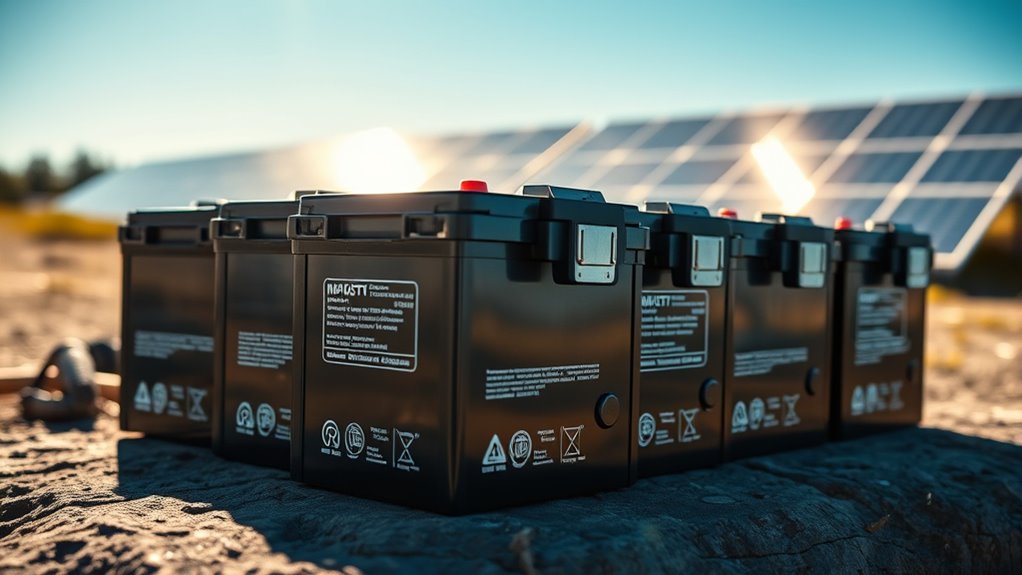
When choosing a 12-volt battery for your solar panels, you’ll want to take into account factors like battery chemistry, capacity, and voltage to match your system’s needs. It’s also important to check the cycle life expectancy and make certain the battery is compatible with your charger.
Don’t forget to think about the temperature range where you’ll be using the battery for reliable performance. These details might seem small, but they really make a difference in how well your system runs. So, a bit of extra attention here goes a long way!
Battery Chemistry Types
Choosing the right battery chemistry plays a pivotal role in how well your 12V solar panel system performs and lasts. Lead-acid batteries, including flooded, AGM, and GEL types, are budget-friendly and tolerant of overcharging but tend to be heavy with shorter cycle lives, typically around 200–800 cycles.
Lithium iron phosphate (LiFePO4) batteries offer a lighter, more energy-dense option with impressive longevity—often 2,000 to over 10,000 cycles—and low self-discharge. Other lithium-ion types provide higher energy density but need careful management due to sensitivity to overcharge and heat.
Less common chemistries like NiMH usually don’t match lead-acid or LiFePO4 in cost-effectiveness or cycle life. Your chemistry choice influences charging needs, battery management systems, safety, weight, and overall lifecycle cost, so choose carefully based on your system’s demands.
Capacity And Voltage
Although selecting the right battery chemistry is crucial, matching the battery’s voltage and capacity to your solar system’s requirements guarantees efficient performance and longevity.
You should choose a battery with a nominal voltage equal to your system’s voltage—most small solar setups use 12 V batteries, like a 12.8 V LiFePO4 or 12.0 V lead‑acid battery at rest—to assure compatibility with your panel, charge controller, and inverter.
Size the battery capacity in amp-hours (Ah) based on your energy needs: multiply capacity by nominal voltage to get watt-hours (Wh). Remember to factor in depth of discharge (DOD) for usable energy.
If you need higher voltage or capacity, you can connect identical batteries in series or parallel. Just be sure to keep matching voltages, capacities, and chemistries for safe, efficient operation.
Cycle Life Expectancy
Since cycle life determines how long your 12V battery will reliably store and deliver energy, it’s a key factor to take into account for solar panel systems.
Cycle life refers to the number of full charge–discharge cycles a battery can handle before its capacity drops to around 70–80% of the original. Keep in mind, the depth of discharge (DoD) greatly impacts cycle life—shallower discharges, like 50–60% DoD, can multiply the number of cycles compared to full 100% discharges.
Battery chemistry also matters: lead-acid batteries typically offer a few hundred cycles at deep DoD, while lithium batteries provide thousands or even tens of thousands.
Charging Compatibility
When selecting a 12V battery for your solar panel system, guaranteeing charging compatibility is essential to maximize performance and lifespan. Match the battery’s chemistry charging profile—like LiFePO4 needing about 14.4–14.6 V bulk/absorb and minimal float voltage—with your solar charge controller’s programmed setpoints.
Make sure the controller’s maximum charging current and algorithm (PWM vs. MPPT, CC-CV support) align with your battery’s voltage and BMS limits to avoid overcurrent or undercharging. Verify your solar array’s open-circuit voltage fits within the controller’s input range to maintain reliable charging.
Also, confirm your battery’s BMS charge cutoffs work with the controller and any additional charging sources. If you connect batteries in series or parallel, use matched units and ensure your system balances cells evenly to prevent imbalance and premature wear.
Temperature Operating Range
Because temperature directly impacts battery performance and longevity, you need to take into account the operating temperature range carefully when choosing a 12V battery for your solar panel system. Most batteries charge safely between 0–45 °C and discharge from about -20 °C up to 60 °C.
Charging below freezing, especially with LiFePO4 batteries, risks lithium plating and permanent damage unless you use heaters or cold-charge prevention chargers. High heat speeds up aging, so keeping your battery under 45 °C during charging—and ideally below 30–35 °C during storage—extends its life.
Since cold reduces capacity and increases resistance, and heat temporarily boosts capacity but shortens lifespan, you should install batteries in shaded, ventilated spots or use thermal management to maintain stable, moderate temperatures for peak performance.
Maintenance Requirements
Although some 12V batteries require more upkeep than others, understanding their maintenance needs helps you maximize performance and lifespan. Flooded lead-acid batteries need periodic watering and equalization charging, along with regular voltage and specific gravity checks to avoid undercharging.
In contrast, sealed batteries like AGM, gel, and LiFePO4 are maintenance-free, requiring no electrolyte refilling. Regardless of type, keep terminals clean, tight, and corrosion-free by performing routine cleaning and torque checks.
Also, managing temperature within recommended charge and discharge ranges reduces capacity loss and maintenance issues. Finally, make sure you use a compatible charge controller to maintain proper charging profiles, preventing sulfation in lead-acid batteries or BMS-triggered cutoffs and imbalances in LiFePO4 banks.
Proper maintenance makes your solar battery system reliable and efficient. It’s definitely worth the effort!
Physical Size Weight
Selecting the right 12V battery for your solar panel system means paying close attention to its physical size and weight. First, measure the intended enclosure’s length, width, and height, including terminal clearance and mounting brackets. This will make certain you get a proper fit.
Check the battery’s weight against your installation constraints. Keep in mind, lead-acid AGM batteries are markedly heavier than lithium options of the same capacity, so your support structures must be sturdy enough.
Also, consider the terminal type and location—whether top, side, or screw terminals—along with bolt lengths and cable bending radius. This helps avoid wiring issues down the line.
Don’t forget to leave space around the battery for ventilation, maintenance, and cooling. If you plan to expand your system with additional batteries, make sure you allocate extra room for interconnect cables and a safe, neat installation.
Safety Features
When choosing a 12V battery for your solar panel system, prioritize safety features that protect both the battery and your setup. Look for a built-in Battery Management System (BMS) that guards against overcharge, over-discharge, over-current, short circuits, and overheating. This helps prevent damage and reduces fire risk.
Make certain the battery has a low-temperature cutoff around 0°C to avoid lithium plating during cold charging. If you’re installing outdoors, pick batteries with at least an IP65 rating. This will shield against dust and water spray.
Check that the maximum continuous discharge and BMS trip current ratings exceed your system’s demands. That way, you can avoid shutdowns or thermal stress. Finally, confirm the battery supports thermal management and operates safely within your climate’s temperature range for charging and discharging.
Frequently Asked Questions
How Do Temperature Extremes Affect 12V Solar Batteries?
Temperature extremes reduce your 12V solar battery’s efficiency and lifespan. Cold slows chemical reactions, lowering capacity, while heat accelerates degradation.
You’ll want to protect your battery from these conditions to maintain peak performance and durability. It really makes a difference in how long your battery lasts and how well it works.
What Maintenance Is Required for Lithium vs. Lead-Acid Batteries?
Think of lithium batteries as low-maintenance pets—they mostly just need occasional voltage checks.
Lead-acid batteries, however, demand more care, like watering plants. You’ll regularly check electrolyte levels and clean terminals to prevent corrosion.
Can 12V Batteries Be Connected in Series for Higher Voltage?
Yes, you can connect 12V batteries in series to increase voltage. Just make sure all batteries have the same capacity and state of charge to avoid imbalance and potential damage to your system.
It’s important to keep things balanced. Otherwise, you might end up with issues that could harm your batteries or the devices you’re powering. So, always double-check before you connect them!
How Long Do Warranties Typically Last on These Batteries?
Warranties on 12-volt solar batteries typically last between 3 to 10 years. You’ll find longer warranties on premium lithium models, while lead-acid batteries usually come with shorter coverage.
Are These Batteries Safe for Indoor Use?
You might think all batteries are dangerous indoors, but many 12-volt solar batteries are actually designed for safe indoor use.
Just make certain proper ventilation and follow manufacturer guidelines to keep your space secure and efficient. It’s really about being cautious and informed.
Conclusion
Choosing the right 12-volt battery for your solar setup is like picking the perfect sidekick for your energy adventure. Whether you want the lightweight power of LiFePO4 or the trusted reliability of AGM, your choice fuels your journey toward energy independence.
Just like every hero needs the right gear, your solar system thrives with the right battery. So, gear up smartly and let your solar story shine bright in 2027 and beyond!
When it comes to solar panels, having the best 12-volt battery makes all the difference. It ensures your energy storage is efficient, reliable, and long-lasting. Whether you’re installing a new system or upgrading an old one, choosing the right battery type can boost your solar power setup’s performance and durability.
In 2027, finding the best 12-volt battery for solar panels means balancing capacity, lifespan, and cost. From AGM to LiFePO4 options, your perfect match is out there. So, make smart choices today for a brighter, energy-independent tomorrow!