What Size Solar Panel Charges a 12V Battery?
To efficiently charge a 12V battery, you’ll want to pick a solar panel that’s about 20-30% higher in wattage than your battery’s capacity. This extra bit helps cover the ups and downs of sunlight and any system losses.
So even on cloudy days, your battery gets enough juice to keep going.
Start by figuring out how much energy you use each day. Then, divide that by the number of peak sunlight hours you get. That gives you a baseline panel size.
After that, add the extra wattage to make sure you don’t come up short. Doing this right not only helps your battery last longer but also stops you from wasting energy.
Keep these tips in mind, and you’ll be on your way to optimizing your whole solar setup with ease.
Key Takeaways
- Size the solar panel 20-30% larger than the 12V battery’s capacity to ensure efficient and reliable charging.
- Calculate panel wattage by dividing daily energy needs (watt-hours) by peak sunlight hours, then add a 20-30% safety margin.
- Account for geographic location and seasonal sunlight variations to adjust panel size for consistent year-round charging.
- Use panels rated for 12V systems and ensure quality wiring to minimize power loss and optimize charging efficiency.
- Regularly maintain panels and monitor battery charge to extend battery life and maintain optimal system performance.
How Battery Size Affects Your Solar Panel Choice
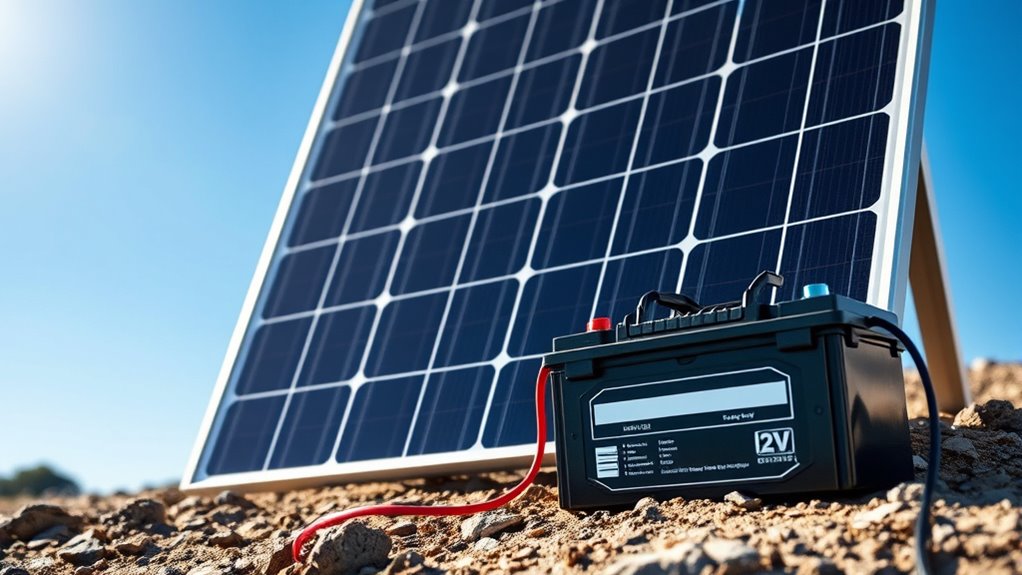
Because your battery size determines how much energy you can store, it directly influences the solar panel size you’ll need. When you have a bigger battery, it holds more charge, so your solar panel must generate enough power to replenish that capacity efficiently.
If your panel is too small, it won’t fully charge the battery, especially during shorter sunlight hours. On the other hand, a panel that’s too large might waste energy since the battery can only absorb so much at once.
Understanding your battery’s amp-hour rating helps you match a solar panel that balances charging speed and efficiency. This guarantees your system runs smoothly, prolongs battery life, and meets your energy needs without unnecessary costs or complexity.
Calculate the Solar Panel Wattage Needed for a 12V Battery

When calculating the solar panel wattage needed for a 12V battery, you’ll first want to take into account the battery’s capacity in amp-hours and your daily energy usage. Multiply your battery’s amp-hour rating by 12 volts to find the total watt-hours stored.
Next, estimate how many watt-hours you consume daily. To guarantee efficient charging, your solar panel should generate at least this amount of energy each day.
Divide your daily watt-hour requirement by the number of peak sunlight hours you expect to receive (covered more in the next section). This calculation gives you the minimum wattage your solar panel needs to produce.
Adding a safety margin of about 20-30% helps compensate for inefficiencies, ensuring your battery charges reliably each day. It’s always better to have a little extra capacity than not enough.
How Sunlight Hours Impact Your Solar Panel Size

You need to take into account how many hours of sunlight you get each day when choosing your solar panel size. Seasonal changes and your geographic location can greatly influence the amount of sunlight available.
Understanding these factors helps guarantee your panel charges your 12V battery efficiently year-round. It’s all about making sure your setup works no matter the season or where you live.
Average Daily Sunlight
How much sunlight does your location receive each day? Knowing the average daily sunlight is vital because it directly affects how quickly your solar panel can charge a 12V battery.
If you get about 4 to 6 hours of good sunlight daily, your solar panel will generate less energy compared to places that get 8 hours or more. You need to factor this into your panel size to guarantee it meets your battery’s charging needs.
For example, if your battery requires 50Ah daily, and you only have 5 hours of sunlight, your panel must produce at least 10 amps per hour. So, understanding your location’s average sunlight helps you pick a solar panel that efficiently charges your 12V battery every day.
Seasonal Sunlight Variations
Average daily sunlight gives a baseline for your solar panel’s output, but sunlight hours can shift considerably with the seasons. During summer, longer days mean your panel gets more charging time, so you might need a smaller panel to keep your 12V battery topped up.
In winter, shorter days and lower sun angles reduce available sunlight, meaning your panel produces less power. To compensate, you’ll want to size your solar panel larger or add extra panels to guarantee your battery charges fully year-round.
Keep in mind that these seasonal changes affect how often and how quickly your battery charges. Planning for the lowest sunlight period helps you avoid power shortages and maintain reliable battery performance throughout the year.
Geographic Location Effects
Although solar panels rely on sunlight to charge your 12V battery, the number of sunlight hours varies widely depending on where you live.
If you’re in a sunny region, like the Southwest US, you’ll get more daily sunlight, so a smaller panel can do the job efficiently. Conversely, if you’re in northern areas or places with frequent cloud cover, you’ll need a larger panel to compensate for shorter or weaker sunlight periods.
Don’t forget to factor in seasonal changes—some locations experience drastic shifts in daylight hours between summer and winter. Understanding your geographic location helps you choose the right panel size, ensuring your battery charges reliably without overspending on unnecessary capacity.
Always check local solar insolation data before making your decision.
How to Choose the Right Solar Panel for 12V Batteries
To choose the right solar panel for your 12V battery, start by calculating how much energy your battery needs to recharge fully. Then, make certain the panel’s output voltage matches your battery’s voltage to ensure efficient charging.
This approach helps you pick a panel that keeps your battery powered without wasting energy. It’s all about matching things up so you get the best performance.
Calculating Battery Charging Needs
When you want to keep your 12V battery fully charged, understanding how much power it needs is essential. Start by checking your battery’s capacity, usually measured in ampere-hours (Ah).
For example, a 12V 100Ah battery stores 1200 watt-hours (Wh) of energy (12V × 100Ah). Next, figure out how many watt-hours you use daily to estimate the energy your solar panel must replenish.
Also, don’t forget to factor in losses from charging inefficiencies, which are typically around 20%. So, multiply your daily consumption by 1.2 to cover that.
Finally, think about how many peak sun hours your location gets. Dividing your adjusted daily watt-hour need by those peak sun hours gives you the minimum solar panel wattage required.
This calculation helps you pick a solar panel that meets your battery’s charging needs efficiently. Easy, right?
Matching Panel Output Voltage
Since your 12V battery requires a specific voltage range to charge safely and efficiently, choosing a solar panel with the right output voltage is vital. Typically, a 12V battery charges best with a panel that produces around 17-18 volts under open-circuit conditions.
This higher voltage ensures the battery receives enough current to charge fully, even accounting for voltage drops in wiring and the charge controller. If the panel’s voltage is too low, it won’t charge the battery properly.
Conversely, too high a voltage can damage the battery or the system. Look for panels labeled as “12V” or “18V” panels, designed specifically for 12V battery systems. Matching output voltage helps optimize charging while protecting your battery’s lifespan.
Why Your 12V Battery Needs a Solar Charge Controller
How do you protect your 12V battery from overcharging and damage? You use a solar charge controller. This device regulates the voltage and current coming from your solar panel to the battery, preventing excessive charge that could shorten battery life or cause overheating.
Without a controller, your battery risks being overcharged on sunny days, which leads to battery degradation or failure. The charge controller guarantees your battery receives the appropriate amount of power, maintaining its health and efficiency.
It also prevents reverse current flow at night, which could drain your battery. In short, a solar charge controller acts as a safeguard, making sure your 12V battery charges safely and lasts longer, optimizing your solar power system’s reliability.
Tips to Optimize Solar Charging for 12V Batteries
A solar charge controller helps protect your 12V battery, but you can do more to get the most from your solar setup. First, position your solar panel where it gets maximum sunlight throughout the day—avoid shade and angle it toward the sun’s path.
Clean the panel regularly to remove dust and debris that reduce efficiency. Use quality wiring and connectors to minimize power loss.
Monitor your battery’s state of charge to avoid overcharging or deep discharge, which shortens battery life. Consider adding a battery monitor for real-time data.
Ultimately, size your panel appropriately—typically 20-30% larger than your battery’s capacity to ensure consistent charging even on cloudy days. Following these tips helps you maximize energy harvest and extends your battery’s lifespan.
Frequently Asked Questions
Can a Solar Panel Charge a 12V Battery in Cloudy Weather?
Yes, your solar panel can charge a 12V battery in cloudy weather, but it’ll work slower since sunlight is weaker.
Make sure your panel is efficient and sized correctly to get the best charge despite clouds.
It might take longer, but with the right setup, you’ll still get some power from those cloudy days.
How Long Does It Take to Fully Charge a 12V Battery?
It takes about 6 to 12 hours to fully charge a 12V battery with a solar panel, depending on the panel’s wattage, sunlight intensity, and battery capacity.
You’ll want to monitor charging for best results. That way, you can make sure everything’s working smoothly and your battery gets the right amount of power.
Are Flexible Solar Panels Effective for Charging 12V Batteries?
Yes, flexible solar panels are effective for charging 12V batteries. They’re lightweight, portable, and easy to install.
But keep in mind, they usually produce less power than rigid panels. So, you’ll need to match their output to your battery’s needs.
Can Multiple Solar Panels Be Connected to Charge One 12V Battery?
You can connect multiple solar panels to charge one 12V battery, boosting your energy. In fact, combining panels can increase output by over 50%, letting you charge faster and power more devices efficiently throughout the day.
It’s pretty straightforward to do, and it really helps if you need extra power. Just make sure the panels are compatible and wired correctly to avoid any issues.
What Maintenance Is Required for Solar Panels Used With 12V Batteries?
You’ll need to clean the panels regularly and check for shading or debris. Inspect wiring for any damage, and make sure all connections stay tight.
Also, keep an eye on battery health and charge controller settings. This will help your system run efficiently and safely.
Conclusion
Choosing the right solar panel size for your 12V battery might seem tricky, but it doesn’t have to be. Even if you think a small panel won’t charge your battery efficiently, remember that calculating wattage based on your battery size and sunlight hours makes all the difference.
With the right panel and a charge controller, you’ll keep your battery healthy and charged. So go ahead—pick a panel that fits your needs and enjoy reliable solar power!
When selecting a solar panel for a 12V battery, consider your battery’s amp-hour capacity and how many hours of sunlight you get daily. A common rule of thumb is to have a panel that produces about 10-20% more wattage than your battery’s capacity to ensure efficient charging.
By choosing the right solar panel size for your 12V battery, you optimize energy capture and battery longevity. Remember, pairing your panel with a quality charge controller is key to preventing overcharging and damage. So, whether you’re powering a small RV or a remote cabin, the right solar panel setup keeps your 12V battery charged and ready to go!