How to Use Solar Panels During a Power Outage in 7 Essential Steps
First, check if your solar system supports outage power by verifying inverter and battery capabilities. This step is crucial to ensure your setup can actually provide power during an outage. Without the right inverter or battery backup, your system won’t function when the grid goes down.
Prepare your battery storage to cover essential devices, making sure it’s fully charged before the outage hits. You want enough stored energy to keep your critical appliances running smoothly. Think about what really matters—like your fridge, lights, or medical equipment—and plan accordingly.
Safely disconnect from the grid before the outage to prevent backfeeding. This is super important for your safety and the safety of utility workers. Then, prioritize powering critical appliances first. After that, use your inverter or backup generator to maintain power for less essential devices.
Keep an eye on your solar output and battery levels regularly to avoid deep discharges, which can damage your system. Once the outage is over, follow the proper steps to safely restore power and reconnect to the grid.
Stick with these steps, and you’ll be well-prepared when the lights go out.
Key Takeaways
– Confirm your solar system supports outage power with a hybrid inverter or backup functionality before relying on it during outages.
It’s super important to know this upfront so you’re not caught off guard when the power goes out.
– Ensure batteries are fully charged and in good condition to supply power when the grid is down.
Having healthy batteries means you’ll have power when you really need it.
– Safely disconnect from the grid by turning off breakers and verifying de-energization before outages.
This step keeps everyone safe and prevents any back-feed to the grid.
– Use an automatic transfer switch to isolate your system and prioritize essential circuits during outages.
This helps make sure your important devices stay powered without manual intervention.
– Monitor solar output and battery levels continuously to optimize energy use and prevent deep discharge.
Keeping an eye on these makes your system work smarter and last longer.
Check If Your Solar System Supports Outage Power
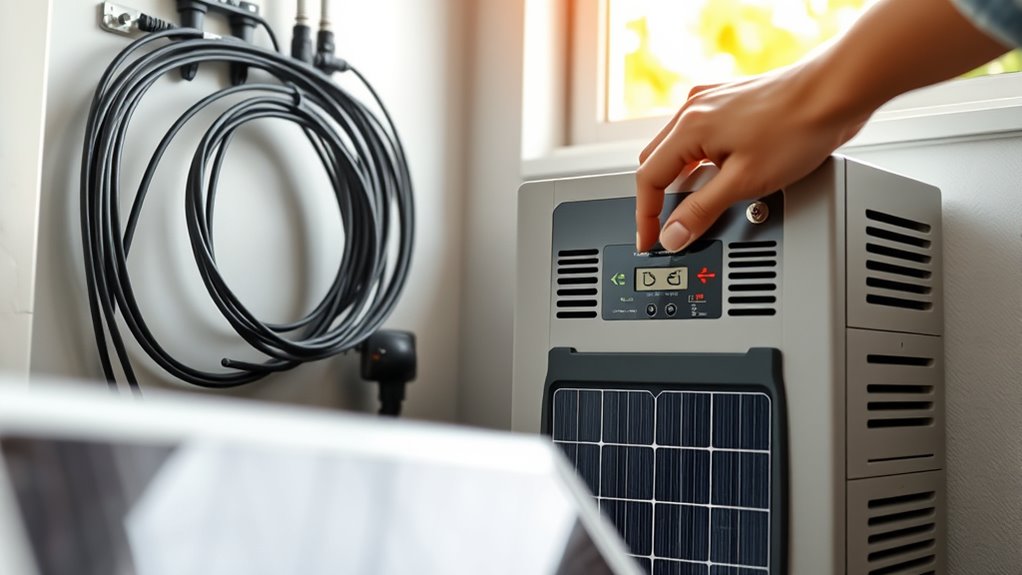
Before you try to use your solar panels during a power outage, you need to confirm whether your system is designed to provide power when the grid goes down. Most standard solar setups automatically shut off during outages to protect utility workers and prevent backfeeding.
To use solar power in an outage, your system must have specific features, like an islanding capability or a backup power mode. Check if your inverter is a hybrid or has backup functionality; these models can isolate your home from the grid and continue supplying power safely.
If you’re unsure, review your equipment manuals or contact your installer. Without this support, your panels won’t supply electricity during an outage, no matter how sunny it is outside.
Prepare Your Solar Battery Storage for Backup Power
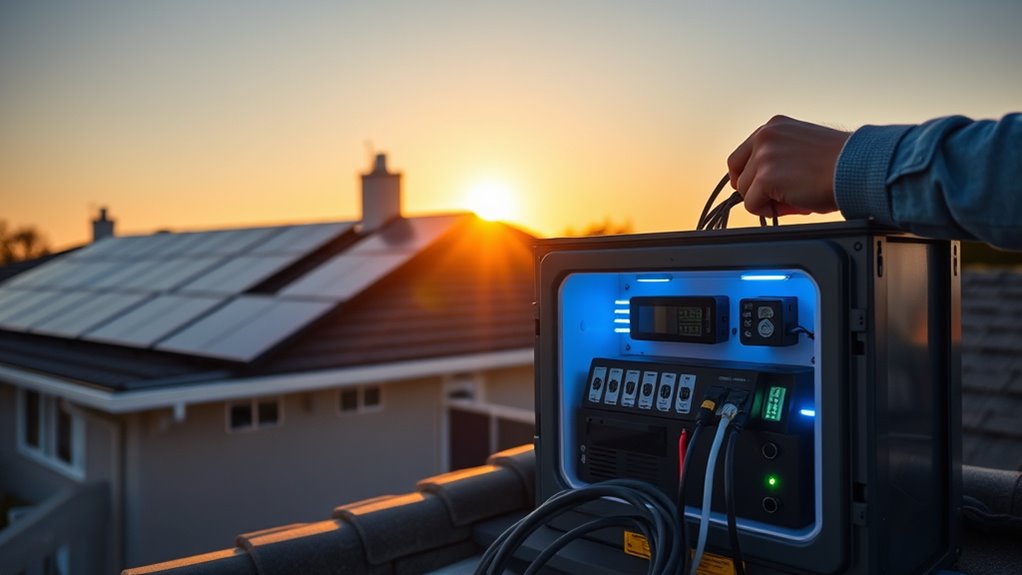
You’ll want to assess your battery’s capacity to guarantee it can handle your backup power needs. Keep up with proper maintenance to maximize performance and lifespan.
Finally, configure your system correctly to switch smoothly during an outage. That way, you won’t have to worry when the power goes out!
Battery Capacity Assessment
When evaluating your solar battery storage for backup power, start by calculating the total energy you’ll need during an outage. List the essential devices you want to power, estimate their wattage, and multiply by the hours of use.
This helps you determine the battery capacity required in watt-hours (Wh).
| Device | Wattage (W) | Hours of Use |
|---|---|---|
| Refrigerator | 150 | 8 |
| LED Lights | 10 | 6 |
| Router | 20 | 24 |
Add these values to find your total energy needs. Then, choose a battery with enough capacity to cover that demand.
Remember to factor in battery efficiency and depth of discharge. This way, your solar battery storage is ready to keep critical devices running during power outages.
Proper Battery Maintenance
Although having sufficient battery capacity is essential, maintaining your solar battery properly guarantees it performs reliably during outages. You should regularly check the battery terminals for corrosion and clean them with a mixture of baking soda and water if needed.
Keep the battery securely mounted and make certain it’s well-ventilated to prevent overheating. It’s important to monitor the battery’s charge levels frequently to avoid deep discharges that can shorten its lifespan.
If you have flooded lead-acid batteries, remember to check electrolyte levels and top them off with distilled water when necessary. Also, avoid exposing the battery to extreme temperatures, as both heat and cold can degrade its performance.
Backup Power Configuration
Setting up your solar battery storage for backup power requires careful planning to guarantee seamless energy delivery during outages. You’ll want to configure your system to isolate from the grid automatically when it goes down, preventing backfeed and ensuring safety.
Use an automatic transfer switch (ATS) to switch power sources smoothly. Also, decide which circuits you’ll prioritize to manage your stored energy efficiently.
Here’s a quick overview:
| Step | Action |
|---|---|
| Isolation | Install an automatic transfer switch (ATS) |
| Prioritization | Select essential circuits for backup power |
| Battery Settings | Configure charge/discharge limits for longevity |
Safely Disconnect Your Solar System From the Electrical Grid
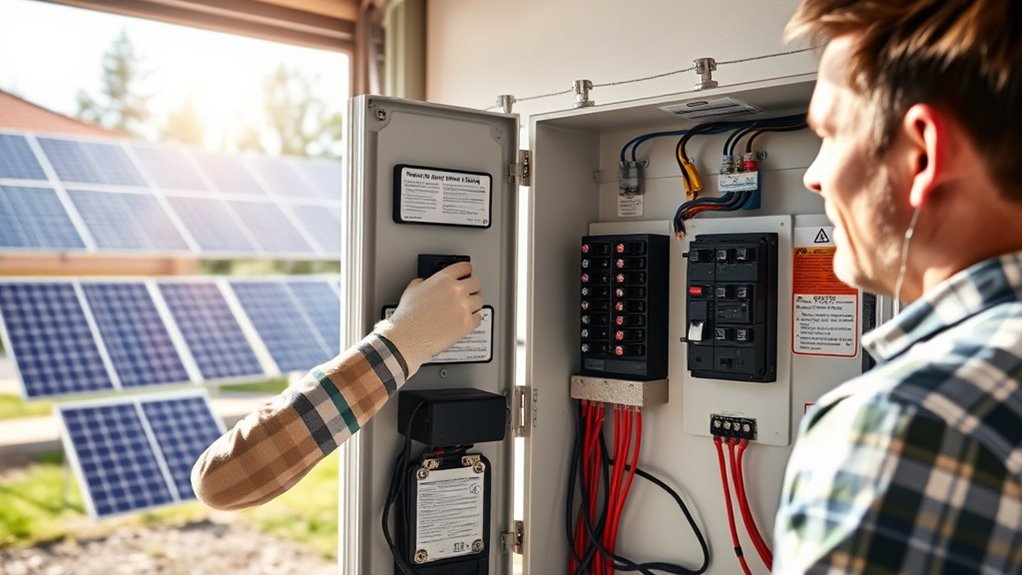
Before relying on your solar panels during a blackout, you’ll need to safely disconnect your system from the electrical grid.
Follow proper grid disconnection procedures to prevent backfeeding and protect utility workers. Always take essential safety precautions to avoid electrical hazards while making the switch.
Grid Disconnection Procedures
When the power goes out, you’ll need to safely disconnect your solar system from the electrical grid to prevent backfeeding. This can endanger utility workers and damage your equipment. So, it’s really important to follow these grid disconnection procedures to keep everything secure.
First, turn off the main breaker that connects your solar inverter to the grid. Then, switch off the AC breaker on your solar inverter to stop the electricity flow.
Also, make sure your solar system has a built-in anti-islanding feature. If it doesn’t, manual disconnection is essential.
Before you start working on the system, confirm the grid is de-energized using a voltage tester. This step keeps you safe while handling the equipment.
Safety Precautions Overview
Although disconnecting your solar system might seem straightforward, taking proper safety precautions is essential to protect yourself and your equipment. Before you begin, always turn off the main breaker to isolate your home’s electrical system from the grid.
Wear insulated gloves and use tools with insulated handles to prevent electric shock. Never attempt disconnection during wet conditions or if you’re unsure about any step.
Make certain to follow the manufacturer’s instructions for shutting down your inverter and solar panels safely. Label all switches clearly to avoid confusion.
If your system includes a battery backup, verify it’s safely disconnected as well. Finally, if you’re uncomfortable or inexperienced, don’t hesitate to call a professional.
Safety comes first when working with solar power systems. Better safe than sorry!
Prioritize Which Devices to Power With Solar Panels
Since solar panels provide limited energy during an outage, you’ll need to prioritize which devices to power carefully. Focus on essentials that keep you safe, comfortable, and connected without draining your system too quickly.
Consider powering these first:
- Refrigerator to keep food from spoiling
- Cell phone and communication devices to stay informed
- Medical equipment like CPAP machines or oxygen concentrators
- LED lights for basic illumination
Try to avoid running high-energy appliances all at once. That way, you make the most of your available power.
Use Your Solar Inverter or Backup Generator During Outages
If your solar panels generate power but your home’s electrical system won’t accept it during an outage, you’ll need to rely on your solar inverter or a backup generator to keep essential devices running.
Your solar inverter converts the DC electricity from your panels into usable AC power, so make sure it’s configured for backup use and connected properly to your home’s circuits. If you have a battery storage system, the inverter manages that power flow, giving you energy even when the sun isn’t shining.
Alternatively, a backup generator can provide power when solar energy is insufficient or unavailable. Just connect it safely to your home’s transfer switch or circuits, following all safety protocols.
Using these tools guarantees continuous power for your critical needs until the grid returns.
Monitor Solar Panel Output and Battery Levels Regularly
To keep your power supply steady during an outage, you’ll want to keep a close eye on how much energy your solar panels are producing and the charge levels in your batteries. Monitoring these helps you avoid unexpected power drops and manage your energy use effectively.
Here’s how to stay on top of it:
- Check your solar inverter’s display or app for real-time energy production.
- Monitor battery charge percentages to prevent deep discharges that can reduce battery life.
- Set alerts on your monitoring system to notify you of low battery or reduced solar output.
- Review performance data daily to spot any issues early and adjust your usage accordingly.
Regular observation ensures your solar setup keeps you powered safely and efficiently during outages. It’s really about staying in the know so you’re never caught off guard.
Safely Restore Power and Reconnect to the Grid
When the power company confirms the outage is resolved, you’ll want to carefully restore power and reconnect your solar system to the grid. First, confirm all your solar equipment, including inverters and batteries, is in good condition and properly charged.
Turn off your main circuit breaker to prevent any backflow of electricity during the reconnection. Then, switch on your solar inverter and battery system. Once stable, gradually close the main breaker to restore power from the grid.
Avoid reconnecting prematurely; doing so can cause damage to your system or pose safety risks. If you have a grid-tied system with automatic transfer switches, verify they operate correctly. When in doubt, consult a licensed electrician to ensure everything is safely reconnected and running smoothly.
Frequently Asked Questions
Can Solar Panels Work During Cloudy or Rainy Weather?
Yes, your solar panels can still work during cloudy or rainy weather, but they’ll produce less energy. They rely on sunlight, so while efficiency drops, they’ll continue generating power.
This is especially true if you have a good battery storage system. It helps store the energy for when the sun isn’t shining bright. So, don’t worry too much about a few cloudy days!
How Long Do Solar Panels Typically Last?
Solar panels are like trusty steeds, usually lasting 25 to 30 years. You’ll get decades of reliable energy, but just like any ride, they need occasional care to keep running smoothly and efficiently for you.
Think of it as giving them a little TLC now and then. That way, they’ll keep powering your home without a hitch!
Do Solar Panels Require Regular Maintenance?
Yes, you’ll need to perform regular maintenance on your solar panels. You should clean them, check for damage, and guarantee connections are secure.
This helps keep them efficient and prolongs their lifespan without unexpected issues. So, staying on top of these simple tasks really pays off!
Can Solar Panels Increase My Home’s Property Value?
Think of solar panels as golden tickets—they can boost your home’s property value by making it more energy-efficient and attractive to buyers.
You’ll likely see a higher resale price and faster sales thanks to those eco-friendly upgrades.
It’s a win-win situation that benefits both your wallet and the environment!
Are Solar Panels Environmentally Friendly to Produce?
Yes, solar panels are environmentally friendly to produce compared to fossil fuels. You’ll find they use fewer resources and emit less pollution during manufacturing.
This makes them a cleaner, greener option for energy generation. Plus, they help reduce your carbon footprint.
Conclusion
By following these steps, you can confidently use your solar panels during a power outage to keep essential devices running. Did you know that homes with solar battery storage can reduce outage downtime by up to 90%?
This means your solar setup isn’t just eco-friendly — it’s a dependable backup. Staying prepared and monitoring your system guarantees you maximize your solar power’s benefits when you need it most.
Using solar panels during a power outage isn’t just about going green; it’s about staying powered when it matters. With the right setup, including solar battery storage, you can enjoy reliable backup energy that keeps your home running smoothly. So, keep your system maintained, stay informed, and make the most of your solar energy when the grid goes down.