How Many Solar Panels to Run AC: Step-by-Step Guide
To figure out how many solar panels you need to run your AC, start by checking its wattage or amperage. Then multiply that by the voltage to find your daily energy use. This gives you a clear idea of how much power your air conditioner consumes each day.
Next, consider your location’s average sunlight hours. Don’t forget to adjust for seasonal changes and weather variations since sunlight availability can vary a lot.
After that, divide your AC’s daily kWh by your panels’ daily output. Be sure to add about 20% more to cover system losses like wiring and inverter inefficiencies.
Choosing the right type of solar panel and balancing cost with performance ensures your setup runs efficiently. Keep exploring each step to better understand how to optimize your solar panel system for running your AC smoothly.
Key Takeaways
- Calculate the AC unit’s daily energy use in watt-hours by multiplying its wattage by hours of operation.
- Convert daily watt-hours to kilowatt-hours (kWh) by dividing by 1,000 for easier solar sizing.
- Estimate daily energy production per solar panel using location-specific sunlight hours and panel wattage.
- Divide the AC’s daily kWh by the panel’s daily kWh output, then add 20% for system losses.
- Select high-efficiency panels compatible with your inverter and balance cost, space, and power needs.
Figuring Out Your AC Unit’s Power Use
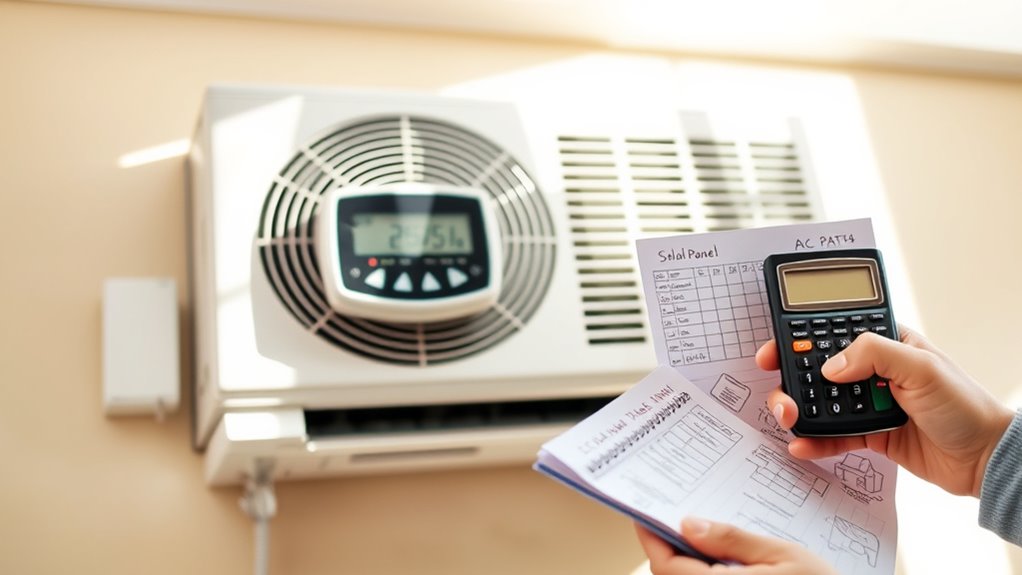
Before you can figure out how many solar panels you need, you first have to know how much power your AC unit uses. Start by checking the label or the manual for its wattage or amperage rating.
To determine your solar panel needs, first find your AC unit’s power usage from its label or manual.
If you find amperage, just multiply it by the voltage—usually 120 or 240 volts—to get the wattage. For example, if your unit draws 10 amps at 240 volts, that means it uses 2,400 watts.
Next, think about how many hours you run your AC each day. Multiply the wattage by those hours to get the daily energy consumption in watt-hours.
Keep in mind, AC units cycle on and off, so the average power use might be lower than the maximum. Knowing this exact number will help you size your solar panel system just right.
How Much Sunlight Will Your Solar Panels Get?
To know how many solar panels you’ll need, you have to contemplate how many hours of sunlight your panels will get each day. Keep in mind, sunlight varies with the seasons, so your panels might produce less power in winter than in summer.
Understanding these changes helps you size your system accurately to run your AC efficiently year-round. It’s all about making sure you have enough juice no matter the season.
Daily Sunlight Hours
The amount of daily sunlight your solar panels receive directly impacts how much energy they can produce. To estimate this, you’ll want to take into account these key factors:
- Location: Different regions get varying sunlight hours; sunny areas yield more energy.
- Orientation: Panels facing south (in the Northern Hemisphere) capture maximum sunlight.
- Tilt Angle: Adjusting panel angles optimizes exposure to the sun throughout the day.
- Obstructions: Trees, buildings, or shading reduce effective sunlight hours considerably.
Seasonal Sunlight Variations
Although your location sets a baseline for sunlight, seasonal changes can dramatically affect how much sun your solar panels actually receive throughout the year.
In summer, longer days mean more sunlight, boosting your panels’ energy output. Conversely, winter’s shorter days and cloudier skies reduce sunlight, lowering production.
You’ll want to contemplate these variations to size your system accurately and ensure your AC runs smoothly year-round.
| Season | Avg. Sunlight Hours/Day | Impact on Solar Output |
|---|---|---|
| Spring | 6-8 | Moderate, increasing output |
| Summer | 8-10 | Peak output, ideal for AC |
| Fall | 5-7 | Decreasing, still adequate |
| Winter | 3-5 | Lowest output, plan accordingly |
Estimating Solar Panels Needed for Your AC
To estimate how many solar panels you need, start by calculating your AC unit’s power usage in watts. Then, figure out the energy output each solar panel can provide based on your location’s sunlight.
This will help you determine the number of panels required to keep your AC running efficiently. It’s a straightforward way to make sure you get just the right amount of power for your cooling needs.
Calculating AC Power Usage
When you want to power your air conditioner with solar panels, you’ll first need to figure out how much electricity your AC unit uses. This step is crucial for estimating how many solar panels you’ll require.
Start by checking the AC unit’s power rating. You’ll usually find this listed in watts or amps on the nameplate.
Next, determine how many hours per day you typically run your AC. This gives you a good idea of your daily usage.
Then, multiply the power rating by the hours of use to get your daily energy consumption in watt-hours (Wh).
Finally, convert watt-hours to kilowatt-hours (kWh) by dividing by 1,000. This is important because solar panels are rated in kilowatts (kW).
Determining Solar Panel Output
Now that you know your AC’s daily energy consumption, you can estimate how much power your solar panels need to generate. Start by considering your location’s average sunlight hours per day, which affects how much energy each panel produces.
For example, if you get 5 peak sun hours daily, a 300-watt panel produces about 1.5 kWh per day (300 watts × 5 hours ÷ 1000). Divide your AC’s daily kWh usage by this number to find the number of panels required.
Don’t forget to factor in system losses—typically around 20%—due to inefficiencies like inverter conversion and shading. By accurately determining solar panel output, you’ll guarantee your setup reliably powers your AC without under- or oversizing your system.
Weather and Location: Impact on Solar Panel Output
Although solar panels can generate electricity in various conditions, your local weather and geographic location play a crucial role in how much energy they produce.
You’ll want to take into account these key factors:
- Sunlight Hours: More daily sunlight means higher energy output. Locations with longer sunny days boost your panels’ efficiency.
- Weather Patterns: Frequent clouds, rain, or snow reduce sunlight exposure, lowering energy generation.
- Temperature: Solar panels work best in cooler temperatures; excessive heat can decrease their efficiency.
- Geographic Latitude: Areas closer to the equator receive more direct sunlight year-round, increasing power production.
Choosing the Right Solar Panels for Your AC Unit
Since your air conditioning unit demands consistent power, selecting the right solar panels is crucial to guarantee reliable energy supply and efficiency. Focus on panels with high efficiency ratings to maximize energy output in limited space.
Selecting high-efficiency solar panels is key to ensuring your air conditioner receives consistent, reliable power.
Monocrystalline panels usually offer the best efficiency, making them ideal if roof space is tight. Also, consider the panel’s wattage; higher watt panels generate more power, reducing the total number you need.
Check the durability and warranty to ensure long-term performance, especially if you live in harsh weather conditions. Finally, make sure the panels are compatible with your inverter and electrical setup to avoid system mismatches.
Choosing the right solar panels ensures your AC runs smoothly and your investment pays off. It’s worth taking the time to get it right!
Balancing Cost and Efficiency in Your Solar Setup
When you plan your solar setup, balancing cost and efficiency plays a key role in getting the most value. You want to avoid overspending on high-efficiency panels if your energy needs don’t justify it. But you also don’t want to buy cheaper panels that underperform.
Here’s how to strike the right balance:
- Calculate your AC unit’s average power consumption to estimate panel requirements accurately.
- Compare panel efficiency ratings with their prices to find the best cost-per-watt ratio.
- Factor in installation and maintenance costs when budgeting for your system.
- Consider future energy needs to avoid costly upgrades later on.
Frequently Asked Questions
How Do Solar Batteries Affect AC Power Availability at Night?
Solar batteries store excess energy during the day, so you can run your AC at night without power interruptions. They guarantee continuous power availability, letting you stay cool even when the sun isn’t shining or during outages.
Pretty handy, right? It means you don’t have to worry about losing your cool just because it’s dark outside or there’s a blackout.
Can Solar Panels Power Multiple Household Appliances Simultaneously?
Sure, solar panels can simultaneously supply several household appliances, but system size and sunlight strength considerably shape success.
You’ll need enough panels and possibly batteries to sustain steady, simultaneous energy supply throughout your space.
It really depends on how much power your appliances draw and how much sunlight your panels get each day.
With the right setup, running multiple devices at once is totally doable!
What Maintenance Is Required for Solar Panels Used With AC Units?
You’ll need to clean your solar panels regularly and check for shading or debris. It’s also important to inspect the wiring and connections to make sure everything is secure.
Don’t forget to monitor the system’s performance as well. Seasonal inspections help guarantee your AC runs efficiently.
If you notice any damage or dirt, it’s best to address it promptly so your system keeps working smoothly.
Are There Government Incentives for Installing Solar-Powered AC Systems?
You can catch government incentives like rays of sunlight—tax credits and rebates light your path when installing solar-powered AC systems.
Don’t miss these opportunities; they’ll cool your home and warm your wallet simultaneously.
How Long Does It Take to Recoup Solar Panel Installation Costs?
You’ll typically recoup solar panel installation costs within 6 to 10 years, depending on your energy usage, local electricity rates, and available incentives.
After that, you’ll enjoy mostly free, clean energy for years to come. It’s a smart investment that pays off over time!
Conclusion
Now that you know how to estimate your AC unit’s power needs and factor in sunlight and location, you’re closer to a smart solar setup.
Keep in mind, an average 1,200-watt AC running 8 hours daily needs about 32 solar panels to stay powered entirely by the sun. That’s a big shift toward energy independence and cutting your electric bill.
With the right balance of cost and efficiency, you can stay cool sustainably. Choosing the right number of solar panels to run your AC not only helps reduce your carbon footprint but also ensures you get the most out of your investment.
So, when planning your solar panel system, consider your AC’s power consumption, local sunlight hours, and panel efficiency for the best results. This way, you can enjoy a cool home powered by clean energy every day.