What Determines How Fast Solar Wind Travels?
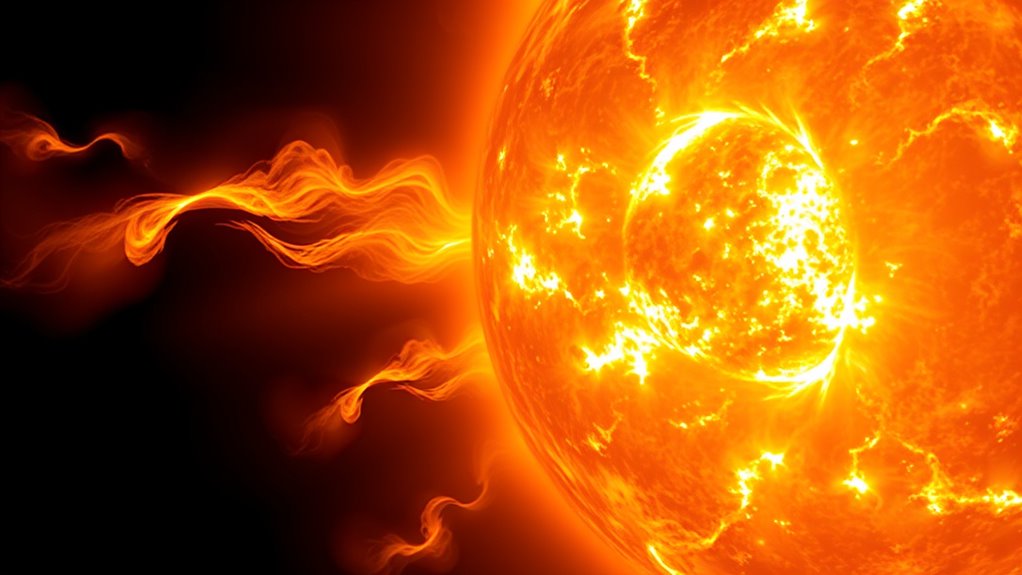
You control how fast solar wind travels by understanding the Sun’s magnetic field, plasma density, and the wind’s origin on the Sun’s surface. These factors play a huge role in shaping the speed of solar wind, which is a stream of charged particles flowing out from the Sun.
Knowing about the Sun’s magnetic environment and where the wind starts helps us predict how fast it will move.
Open magnetic fields in coronal holes let particles escape quickly, creating high-speed wind. In contrast, closed magnetic loops trap particles, slowing the wind down.
Higher plasma density means more collisions, which also slows things. Where the wind starts and the magnetic environment guide its speed.
Exploring these factors reveals more about solar wind behavior.
Key Takeaways
- The solar wind speed is influenced by the Sun’s magnetic field topology, with open field lines enabling faster wind escape. Coronal holes with open magnetic fields produce high-speed solar wind streams due to reduced magnetic resistance.
- Plasma density affects wind speed; lower density allows faster acceleration by minimizing particle collisions. Solar wind originating from coronal holes tends to be faster and less dense than wind from closed magnetic loops.
- Variations in magnetic field strength and structure directly impact solar wind velocity and space weather effects. So, the way the Sun’s magnetic field is arranged really shapes how fast the solar wind travels.
What Is Solar Wind?
What exactly is solar wind, and why should you care? Solar wind is a continuous stream of charged particles, mainly electrons and protons, that flow outward from the Sun’s hot outer atmosphere, called the corona.
You should care because this wind shapes space weather, affecting satellites, communication systems, and even power grids on Earth. It’s not like the wind you feel outside; it’s a plasma flowing through space at high speeds.
As you track its journey, you’ll notice it carries the Sun’s magnetic field with it, influencing the entire solar system. Understanding solar wind helps you grasp how the Sun interacts with planets, including Earth.
This makes it essential for space exploration and protecting modern technology. So, yeah, solar wind might not be something you think about every day, but it plays a big role in our cosmic neighborhood.
Why Solar Wind Speed Varies
You’ll notice the solar wind speed changes because of factors like the Sun’s magnetic field and the presence of coronal holes. These holes let faster wind escape, while variations in plasma density also play a role.
Understanding these elements helps you grasp why the solar wind isn’t constant. It’s not just one thing causing the changes—it’s a mix of different effects working together.
Solar Magnetic Field
Although the solar wind flows continuously from the Sun, its speed varies considerably due to the complex structure of the solar magnetic field. When you look closely, you’ll see that magnetic field lines twist and loop around the Sun’s surface, creating regions where particles can either escape easily or get trapped.
In areas where the magnetic field lines open outward into space, the solar wind can accelerate rapidly, reaching higher speeds. Conversely, where magnetic loops close back onto the Sun, the particles slow down or get confined, resulting in slower solar wind streams.
This intricate magnetic topology shapes how fast the solar wind travels, influencing space weather and affecting how charged particles interact with planets like Earth. Understanding these magnetic patterns helps you predict solar wind behavior better.
Coronal Hole Influence
How do coronal holes affect the speed of the solar wind? Coronal holes are regions on the Sun’s surface where the magnetic field opens directly into space. Because these areas lack the usual closed magnetic loops, they allow solar wind particles to escape more freely and accelerate faster.
When you observe the solar wind streaming out of a coronal hole, you’ll notice it moves at higher speeds compared to wind from other regions. This happens because the open magnetic field lines reduce resistance, letting charged particles flow unimpeded.
Plasma Density Effects
Since the solar wind consists of charged particles, its speed depends heavily on plasma density—the number of particles packed into a given space. When plasma density is high, particles collide more frequently, slowing the solar wind.
Conversely, lower plasma density means fewer collisions, allowing the solar wind to accelerate faster as it escapes the Sun’s gravity and magnetic forces. You can think of it like traffic: dense plasma creates congestion, while sparse plasma offers a clear path.
Consider how plasma density impacts you:
- It shapes space weather, affecting satellite safety and communications.
- It influences the auroras you marvel at on Earth.
- It determines radiation levels that can disrupt astronauts.
- It helps scientists predict solar storm intensity and timing.
Understanding plasma density helps you grasp why solar wind speeds aren’t constant. It’s pretty neat once you get the hang of it!
How the Sun’s Magnetic Field Affects Solar Wind Speed
When you observe the Sun’s magnetic field, you’ll notice it plays a pivotal role in shaping the speed of the solar wind. The Sun’s magnetic field lines guide charged particles, creating channels where the solar wind can accelerate.
In regions where magnetic field lines open into space, called coronal holes, particles escape more easily, resulting in faster solar wind streams. Conversely, closed magnetic loops trap particles, slowing the wind’s escape.
Changes in the magnetic field’s strength and structure directly influence how quickly solar wind particles move. By studying these magnetic patterns, you can better predict solar wind speed variations.
How Solar Corona Temperature and Density Influence Solar Wind Speed
The Sun’s magnetic field sets the stage for solar wind speed, but the temperature and density of the solar corona play a powerful role in driving those particles outward. When the corona is hotter, it energizes particles more, pushing them to higher speeds.
Conversely, a denser corona means more particles crowding together, which can slow the solar wind down. You can think of it like steam from a boiling pot—higher heat creates a stronger, faster flow.
Consider how these factors impact you:
- Feel the awe knowing immense heat powers particles racing through space.
- Imagine the delicate balance between density and speed shaping cosmic weather.
- Appreciate how changes in the corona affect satellite safety and communications.
- Sense the dynamic forces that connect you to the Sun’s invisible breath.
How Solar Wind Origin Location Impacts Speed
Although the Sun’s magnetic field and corona conditions influence solar wind speed, where the wind originates on the Sun also plays an essential role. You’ll find that solar wind emerging from coronal holes—regions with open magnetic field lines—typically moves faster. These areas allow particles to escape more easily, accelerating the wind.
Conversely, wind coming from closed magnetic loops or active regions tends to be slower and denser. When you track the wind’s source, you can see that its speed varies depending on the magnetic environment and local plasma conditions.
Measuring and Predicting Solar Wind Speed
Since solar wind speed varies based on its origin and magnetic conditions, accurately measuring and predicting it becomes essential for understanding space weather. You rely on spacecraft like the Parker Solar Probe and ACE to gather real-time solar wind data.
Scientists use this to forecast how fast the wind will blow and when it might impact Earth. Predicting solar wind speed helps protect satellites, power grids, and astronauts.
When you think about it, these efforts:
- Shield our technology from unexpected solar storms
- Safeguard astronauts exploring the harsh space environment
- Help prevent power outages caused by geomagnetic disturbances
- Allow scientists to prepare for sudden changes in space weather
Frequently Asked Questions
How Does Solar Wind Affect Earth’s Climate?
Solar wind affects Earth’s climate by interacting with the magnetosphere, causing geomagnetic storms that influence atmospheric circulation and cloud formation.
You might notice subtle changes in weather patterns during intense solar activity periods. It’s pretty interesting how space weather can have a say in what happens down here on Earth!
Can Solar Wind Disrupt Satellite Communications?
Yes, solar wind can disrupt satellite communications. During strong solar storms, it can cause signal blackouts lasting up to several hours. This affects GPS accuracy and satellite operations.
What Instruments Detect Solar Wind Particles?
You use instruments like Faraday cups, electrostatic analyzers, and magnetometers to detect solar wind particles. These tools measure particle speed, density, and magnetic fields.
They help you study solar wind’s impact on space weather and satellite systems. It’s pretty fascinating how these instruments give us a clearer picture of what’s happening out there in space.
How Does Solar Wind Interact With Earth’s Magnetosphere?
You’ll see solar wind particles zip at about 400 km/s, slamming into Earth’s magnetosphere. This interaction causes geomagnetic storms, which can disrupt satellites and create dazzling auroras near the poles.
Sometimes, if you’re lucky, you can spot these beautiful light shows in the night sky. It’s pretty amazing how space weather can have such a visible effect right here on Earth!
Are There Any Health Risks From Solar Wind Exposure?
You won’t face health risks from solar wind exposure on Earth because our atmosphere and magnetosphere protect you.
However, astronauts outside this protection need shielding to avoid radiation from solar wind particles during space missions. It’s pretty important for their safety when they’re out there in space.
Conclusion
Imagine the solar wind as a river flowing from the Sun, its speed shaped by unseen currents—the Sun’s magnetic fields, coronal temperature, and where it springs from. Just like a river’s pace changes with the terrain, solar wind speeds shift depending on these factors.
By understanding these cosmic influences, you can better predict how this stellar breeze will rush through space. This helps us see how the solar wind shapes the environment around Earth and beyond.
So, the speed of the solar wind really depends on a few key things: the Sun’s magnetic fields, how hot the corona is, and the specific regions on the Sun where the wind originates. Knowing this lets scientists forecast space weather, which is super important for protecting satellites, astronauts, and even power grids here on Earth. In short, the solar wind’s journey through space is a dynamic flow, influenced by the Sun’s complex magnetic and thermal conditions.