How Many Solar Watts Can a Victron 50 Amp Solar Controller Handle?
You can safely handle up to 600 watts on a 12V system, 1200 watts on 24V, or 2400 watts on 48V with your Victron 50 amp solar controller by matching the voltage and current limits precisely.
This means paying close attention to both the total wattage and the current your solar panels produce.
Make sure your panel’s total current doesn’t exceed 50 amps to avoid overheating or damage.
Properly sizing your system protects the controller and batteries while maximizing efficiency.
It’s all about balance—getting the right wattage and current ensures your Victron controller runs smoothly without stress.
Keep exploring to optimize your setup and extend your system’s lifespan.
Key Takeaways
- A Victron 50A solar controller can handle up to 50 amps of current safely without overload. The maximum solar wattage it supports depends on your system voltage.
- For example, it can manage up to 600W on a 12V system, 1200W on a 24V system, and 2400W on a 48V system. It’s important to ensure your panel voltage and current don’t exceed these limits.
- Doing so helps prevent damage and keeps your system running efficiently. Overloading the controller can cause it to overheat or shut down.
- Plus, it can shorten the overall lifespan of your system. Matching your panel wattage and voltage properly is key to maximizing efficiency and keeping everything safe.
Understanding Current and Voltage for Victron 50 Amp Controllers

Before you connect your solar panels, you need to understand how current and voltage affect your Victron 50 amp solar controller. The controller manages the flow of electricity between your solar panels and battery bank.
Current, measured in amps, represents the flow of electricity, while voltage is the electrical pressure pushing that current. Your Victron 50 amp controller can safely handle up to 50 amps of current without overheating or damage.
Current measures electricity flow in amps, voltage is the pressure pushing it, and your Victron 50 amp controller handles up to 50 amps safely.
However, voltage must also match the controller’s specifications—usually 12V, 24V, or 48V systems. If your solar array’s voltage is too high or too low, the controller won’t operate efficiently and could be damaged.
Maintaining current and voltage within recommended limits ensures safe, reliable charging and extends your controller’s lifespan. It’s all about keeping things balanced so your system runs smoothly.
Calculating Max Solar Watts for Victron 50 Amp Controllers

Now that you understand how current and voltage impact your Victron 50 amp controller, you can calculate the maximum solar wattage it can handle. Multiply the maximum current (50 amps) by the system voltage (usually 12V, 24V, or 48V).
This gives you the wattage limit you shouldn’t exceed to keep your system safe and efficient.
| System Voltage (V) | Max Solar Watts (W) |
|---|---|
| 12 | 600 |
| 24 | 1200 |
| 36 | 1800 |
| 48 | 2400 |
| 60* | 3000* |
*Note: 60V is beyond typical use and may risk controller damage. Always check your specific model’s specs.
What Happens If You Exceed Your Controller’s Capacity?
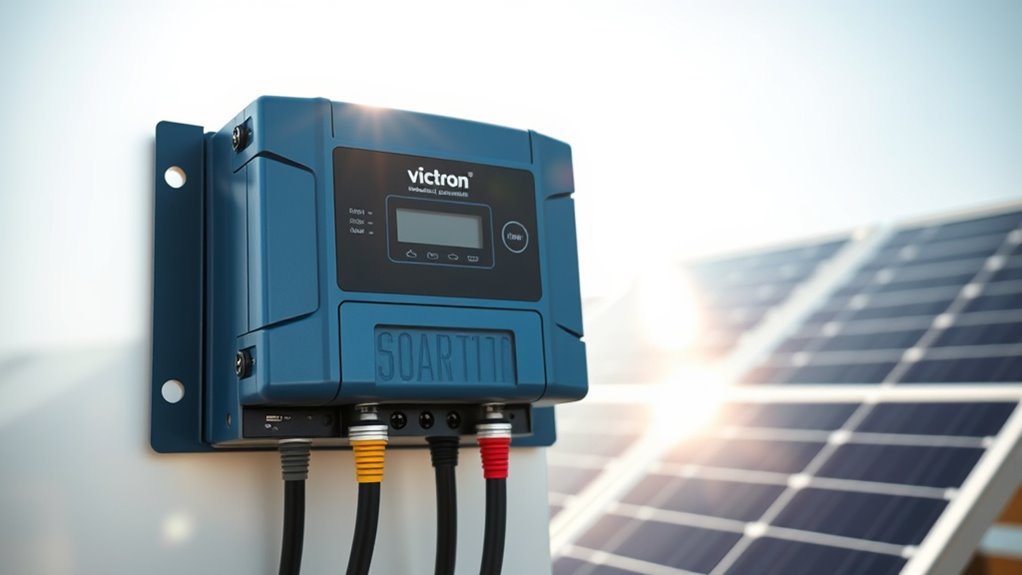
If you push your Victron 50 amp controller beyond its limits, you risk overloading the system and causing damage. This can reduce your solar setup’s efficiency and lifespan.
Let’s look at what happens when the controller can’t handle the extra power. It’s not just about immediate failure – the long-term effects can be pretty serious too.
Controller Overload Risks
When you push a Victron 50 amp solar controller beyond its rated capacity, it can quickly lead to overheating, system inefficiencies, or even permanent damage. The controller is designed to handle a maximum current; exceeding this causes internal components to stress and heat up, risking failure.
You might notice the controller shutting down unexpectedly or triggering protective features to prevent harm. If these safeguards fail, you could face irreversible damage, meaning costly repairs or a full replacement.
Additionally, the excess current may cause wiring to overheat, increasing fire hazards. To avoid these risks, always match your solar array’s wattage and amperage to your controller’s specifications.
Ignoring these limits puts your entire solar setup at risk, so don’t take chances with overload. It’s better to be safe and keep everything running smoothly!
Impact on System Efficiency
Although exceeding your Victron 50 amp solar controller’s capacity might seem like a way to boost power, it actually reduces your system’s overall efficiency. When you push the controller beyond its limits, it can’t regulate the current properly, causing energy losses.
The excess current may trigger the controller’s protective features, leading to frequent shutdowns or throttling, which interrupts power flow. This not only wastes the potential energy your panels produce but also stresses the controller, shortening its lifespan.
Plus, your batteries might not charge effectively, which reduces their performance and longevity. To keep your system running smoothly, match your solar array’s wattage to the controller’s maximum current rating.
Doing this ensures you get the most efficient and reliable energy harvest without risking damage or inefficiency.
Tips to Optimize Solar Panel Setup With Victron 50 Amp Controllers
To get the most from your Victron 50 Amp controller, make sure your panel voltage matches its input range and never exceed its maximum current limit.
You’ll also want to carefully decide between series or parallel wiring to balance voltage and current effectively.
These steps will help you maximize efficiency and protect your system from damage.
Panel Voltage Compatibility
Since your Victron 50 amp solar controller has specific voltage limits, you need to make sure your solar panel setup matches these requirements. This helps avoid damage and keeps everything running efficiently.
The controller usually supports panels with voltage ranges that work with 12V, 24V, or 48V battery systems.
To ensure compatibility, first check the open-circuit voltage (Voc) of your solar panels. It shouldn’t go over the controller’s maximum voltage rating.
You can wire panels in series or parallel to adjust the voltage so it fits within the controller’s input range.
Try not to mix panel voltages that could push the input beyond limits, as this might cause the controller to malfunction.
Before you finish installation, use a multimeter to check the panel voltage under different conditions.
Following these steps will help keep your system safe and running at its best.
Maximum Current Handling
When you set up your solar panels with a Victron 50 amp controller, you need to make certain the total current from your panels doesn’t exceed the controller’s maximum input. This controller can handle up to 50 amps of current, so your combined panel output must stay within that limit to avoid damaging the unit or triggering safety shutdowns.
To optimize performance, calculate the short-circuit current (Isc) ratings of your panels and ensure their sum doesn’t surpass 50 amps. Keep in mind that ambient conditions can cause current spikes, so it’s wise to include a margin below the maximum rating.
Properly sizing your solar array current helps maintain controller longevity and system stability. You definitely don’t want to risk overload or inefficiency by pushing it too close to the limit.
Series Vs Parallel Wiring
Although wiring your solar panels in series or parallel affects the voltage and current differently, understanding these configurations is essential for optimizing your Victron 50 amp controller’s performance. Choosing the right setup helps you maximize power without exceeding the controller’s limits.
Here’s what you need to know:
- Series Wiring increases voltage while keeping current constant, perfect for matching the controller’s voltage range.
- Parallel Wiring raises current but keeps voltage steady, which can risk surpassing the 50-amp limit.
- Series setups typically reduce wiring losses over long distances, improving efficiency.
- Parallel setups offer redundancy—if one panel fails, the rest still produce power.
Choosing the Right Victron Controller for Larger Solar Arrays
To effectively manage larger solar arrays, you’ll need a Victron controller that matches the system’s power capacity and voltage requirements. Start by calculating your total solar panel wattage and the system voltage.
If your array exceeds what a 50-amp controller can handle—typically around 700 watts at 12 volts—you’ll want to look into controllers with higher amperage ratings, like 100A or even 150A models. Also, verify the controller supports your battery bank voltage, whether it’s 12V, 24V, or 48V.
Victron offers scalable solutions, so you can parallel multiple controllers for even bigger setups. Choosing the right controller prevents overload, optimizes power conversion, and protects your investment.
Matching the controller’s specs to your system keeps your solar setup safe and efficient. It’s all about making sure everything works smoothly together.
Reading Victron Controller Specs to Maximize Solar Output
Understanding how to read your Victron controller’s specifications lets you get the most out of your solar setup. You’ll know exactly how much power you can safely handle without damaging your system or losing efficiency.
Here’s what to focus on:
- Maximum Current Rating – Check the amp rating; a 50 Amp controller means it can handle up to 50 amps of current from your solar array.
- Maximum Solar Voltage – This tells you the highest voltage your solar panel bank can safely feed into the controller.
- Battery Voltage Compatibility – Make sure the controller matches your battery bank’s voltage (12V, 24V, or 48V).
- Power Rating in Watts – Multiply the max current by the max voltage to find the maximum wattage your controller supports.
Frequently Asked Questions
Can a Victron 50 Amp Controller Be Used With Lithium Batteries?
Yes, you can use a Victron 50 amp controller with lithium batteries. It supports customizable charging profiles, so you can optimize charging for lithium types.
This ensures safe, efficient battery management and helps extend your battery’s lifespan. Pretty handy, right?
How Does Temperature Affect Victron Solar Controller Performance?
Think of your Victron controller like a runner—when it’s too hot, it slows down to avoid overheating. High temperatures can reduce charging efficiency, so you’ll want proper ventilation to keep it functioning at its best.
Keeping it cool is key. If it gets too warm, the controller won’t work as efficiently, and that can affect your solar setup’s overall performance. So, make sure there’s good airflow around it.
What Maintenance Is Required for Victron 50 Amp Solar Controllers?
You’ll want to regularly clean the controller’s vents and check wiring connections for corrosion or looseness. These simple steps help prevent common issues and keep everything working properly.
Also, make sure to update the firmware whenever there’s a new version available. This keeps your Victron 50 Amp solar controller running smoothly with the latest features and fixes.
Lastly, it’s important to keep the controller in a dry, cool environment. Doing so protects it from damage and helps extend its lifespan.
Are Victron Controllers Compatible With Off-Grid and Grid-Tied Systems?
You’ll find Victron controllers absolutely master both off-grid and grid-tied systems effortlessly. They’re designed to seamlessly manage energy flow, ensuring your solar setup runs smoothly, no matter how complex or demanding your power needs get.
It’s pretty impressive how they adapt to different setups without breaking a sweat. Whether you’re going fully off-grid or connected to the main grid, Victron’s got you covered.
Can Victron Solar Controllers Be Monitored Remotely via an App?
Yes, you can monitor Victron solar controllers remotely using the VictronConnect app. It lets you track performance, adjust settings, and receive alerts easily from your smartphone or tablet.
This way, you’re always in control, no matter where you are. It’s pretty convenient and keeps you connected to your system at all times.
Conclusion
Think of your Victron 50 amp solar controller like the throttle of a powerful motorcycle—it controls how much energy flows safely. Just as pushing the throttle too far risks engine damage, exceeding 50 amps can overload your controller.
By understanding its limits, around 600 watts at 12V or 1200 watts at 24V, you keep your system running smoothly. Staying within these bounds helps prevent damage and ensures efficient energy management.
So, if you want your solar setup to run strong and efficient every day, remember to match your solar panel wattage to the controller’s capacity. Keeping your Victron 50 amp solar controller within its wattage limits is key to a reliable and long-lasting solar power system.