How to Calculate Solar Panel Battery and Inverter in 5 Steps
To calculate your solar panel battery and inverter, start by estimating your daily power use. Multiply each device’s wattage by the hours you use it, then add everything up to get the total energy consumption. This step helps you understand how much power you need from your solar system.
Next, adjust for system efficiency and include a safety margin. This covers any losses in the system and future power needs you might have. It’s always better to have a little extra capacity than to fall short.
When calculating battery capacity, consider how many days of autonomy you want, the battery’s depth of discharge, and the system voltage. These factors ensure your battery can supply power when sunlight isn’t available.
For the inverter, pick one that can handle the total wattage of your devices plus any surge power requirements. Don’t forget to add a safety margin here as well.
Finally, make sure your battery voltage matches the inverter’s input voltage for smooth and efficient operation.
Keep reading to discover detailed steps on how to size each component perfectly for your solar setup.
Key Takeaways
- Calculate total daily watt-hours by listing devices, their wattage, and usage hours. This gives you a clear picture of your daily energy needs.
- Adjust energy needs for system efficiency losses and add a 10-20% safety margin. It’s always good to have a buffer to cover unexpected usage or losses.
- Determine battery capacity by factoring autonomy days, depth of discharge, and converting Wh to Ah. This helps ensure your battery can store enough energy for your needs.
- Size the inverter by summing device wattage plus startup surge and adding a 20-30% safety margin. That way, your inverter can handle the power demand without any hiccups.
- Ensure battery voltage matches the inverter input and panel output for compatibility and system stability. Matching these components keeps everything running smoothly and safely.
Estimate Your Daily Power Consumption for Battery Sizing

Before sizing your battery, you need to estimate your daily power consumption accurately. Start by listing all the electrical devices you plan to power with your solar setup.
Note each device’s wattage, usually found on the label or in the manual. Then, estimate how many hours per day each device runs. Multiply the wattage by the hours used to get the daily energy consumption in watt-hours (Wh) for each device.
Add up all these values to find your total daily power consumption. This total helps you determine the battery capacity you’ll need.
Adjust for System Efficiency and Safety Margins in Your Solar Setup
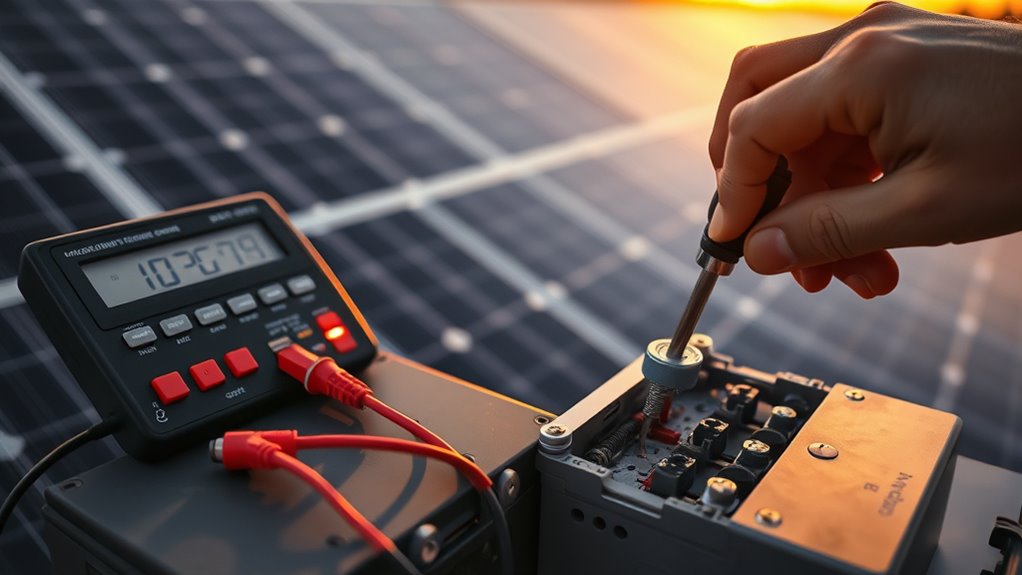
Since no system operates at 100% efficiency, you’ll need to adjust your calculations to account for energy losses and safety margins. Components like solar panels, batteries, and inverters all have inherent inefficiencies—panels rarely convert all sunlight, batteries lose capacity over time, and inverters waste some energy during conversion.
To guarantee your system meets your needs, multiply your total energy requirement by an efficiency factor, typically between 0.7 and 0.85. This accounts for losses like wiring resistance, temperature effects, and inverter inefficiency.
Also, it’s a good idea to add a safety margin of around 10-20%. This helps cover unforeseen conditions or any future increases in load.
Calculate the Ideal Battery Capacity for Your Solar System
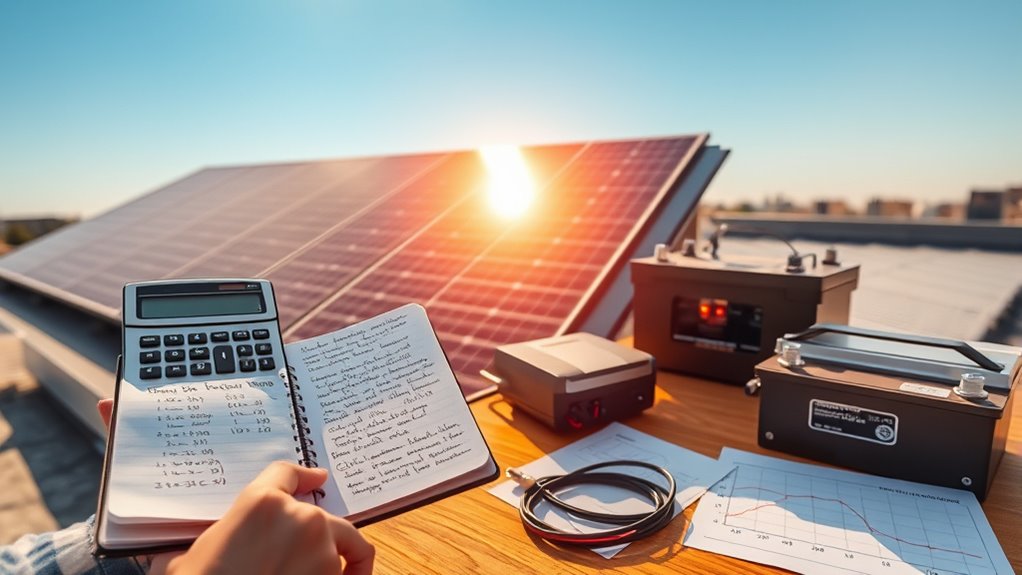
When sizing your battery, you’ll want to guarantee it can store enough energy to power your needs during periods without sunlight. Start by calculating your daily energy consumption in watt-hours (Wh). Multiply the total wattage of all devices by the hours you use them each day.
Next, decide how many days of autonomy you want—typically one to three days—so your system can function during cloudy weather. Then, factor in the battery’s depth of discharge (DoD); for example, if your battery’s DoD is 80%, divide the total energy you need by 0.8 to avoid damaging the battery.
Finally, convert watt-hours to ampere-hours (Ah) by dividing by your battery voltage (usually 12V or 24V). This gives you the ideal battery capacity for your solar system. Easy, right? Just follow these steps and you’ll be set!
Determine the Right Inverter Size Based on Your Load Needs
Although choosing the right inverter size might seem straightforward, getting it wrong can lead to inefficiencies or equipment damage.
To determine the correct inverter size, start by listing all the appliances and devices you plan to power. Calculate their total wattage, including any surge power required for startup, especially for motors or compressors.
Add a safety margin—typically 20-30%—to handle unexpected loads or future additions. Choose an inverter with a continuous power rating that meets or slightly exceeds this total wattage.
Avoid undersizing, which can cause frequent overloads, or oversizing, which wastes money and reduces efficiency. By carefully matching your inverter size to your load needs, you’ll guarantee reliable performance and protect your system components from unnecessary strain.
Ensure Battery and Inverter Compatibility With Your Solar Panels
To get the most out of your solar power system, you need to guarantee your battery and inverter work seamlessly with your solar panels. Compatibility ensures efficient energy storage and conversion, preventing power loss or equipment damage.
Ensure your battery and inverter perfectly align with your solar panels for optimal energy efficiency and system protection.
Start by matching the battery voltage with your solar panel’s output voltage to keep the system stable. Next, check the inverter’s input voltage range to confirm it supports your battery bank and panel setup.
Ultimately, consider the inverter’s capacity to handle your peak load without strain. Focus on these key points:
- Battery voltage alignment with solar panel output
- Inverter input voltage compatibility
- Inverter capacity matching your energy needs
Doing this will keep your system reliable and running smoothly. It’s all about making sure everything works together without a hitch!
Frequently Asked Questions
What Types of Batteries Are Best for Solar Energy Storage?
You’ll want lithium-ion batteries for solar energy storage because they’re efficient, long-lasting, and require less maintenance.
Alternatively, lead-acid batteries are cheaper but bulkier and have shorter lifespans.
Choose based on your budget and needs. It really depends on what works best for you!
How Often Should Solar Batteries Be Maintained or Replaced?
You should maintain your solar batteries every 3-6 months. This helps keep them in good shape and ensures everything runs smoothly.
Expect to replace your batteries roughly every 5-15 years. That timeframe usually matches the typical warranty periods.
Doing this will keep your system performing at its best. Plus, it helps you avoid any unexpected energy interruptions.
Can I Use an Inverter for Both Solar and Grid Power?
Yes, you can use an inverter for both solar and grid power if it’s a hybrid inverter. It automatically switches between sources, ensuring seamless energy supply without manual intervention.
Just choose one that’s compatible with your system. That way, you’ll get the best performance without any hassle.
What Safety Precautions Are Needed When Installing Solar Batteries?
You should wear protective gear and guarantee proper ventilation. Also, avoid sparks near batteries to keep things safe.
Before you start the installation, disconnect power and use insulated tools. It’s really important to follow the manufacturer’s guidelines.
Always handle batteries carefully to prevent acid leaks and electrical shocks. Taking these steps helps ensure a safe installation process.
How Does Temperature Affect Solar Battery Performance?
You’ll see reduced battery capacity and lifespan when temperatures rise, while cold temperatures slow chemical reactions, limiting performance.
Conclusion
Now that you’ve revealed the secrets to sizing your solar battery and inverter, you’re ready to harness the sun’s power like a pro. Think of your solar setup as a symphony—each part playing its role in perfect harmony.
With the right calculations, you’ll keep your energy flowing smoothly, turning sunlight into a reliable, green lifeline. This means your solar panel battery and inverter work together seamlessly to store and convert energy whenever you need it.
So, go ahead—let your solar journey shine bright and power your world effortlessly! By understanding how to calculate solar panel battery capacity and inverter size, you ensure maximum efficiency and sustainability for your home or business.
Embrace these steps, and watch your solar system deliver clean, dependable energy day after day.