How Rare Are Solar Eclipses and How to Observe Them
You’ll see a solar eclipse somewhere on Earth about every 18 months, making these events fairly regular but still exciting to catch. However, experiencing a total solar eclipse from the same spot is quite rare because the Moon’s shadow is narrow and follows a specific orbit.
This means you might have to travel or wait many years to witness totality again in your area.
To watch safely, always use ISO-certified eclipse glasses or indirect methods like pinhole projectors. Direct viewing without protection is only safe during the brief period of totality when the Sun is completely covered.
Knowing the exact path and timing of the eclipse is super helpful for planning your viewing. Keep exploring and stay curious to find out when and where you can witness these amazing solar eclipse events next!
Key Takeaways
- Solar eclipses happen around the world roughly every 18 months. There are usually between 2 to 5 events each year, including partial, annular, and total eclipses.
- Total solar eclipses are pretty rare if you’re looking from any one spot on Earth. That’s because the Moon’s shadow is narrow and the Earth-Moon-Sun alignment keeps changing.
- The path where you can see totality is about 100 to 160 km wide. This depends on the exact movements of the Moon and the Earth’s orbit.
- Make sure to always use ISO-certified eclipse glasses or try indirect viewing methods to watch solar eclipses safely. Never look directly at the Sun except during the brief period of totality.
- It’s a good idea to plan ahead by checking eclipse maps and the weather forecast. Don’t miss upcoming events like the total solar eclipse on April 8, 2024, visible in North America.
How Often Do Solar Eclipses Happen Worldwide?
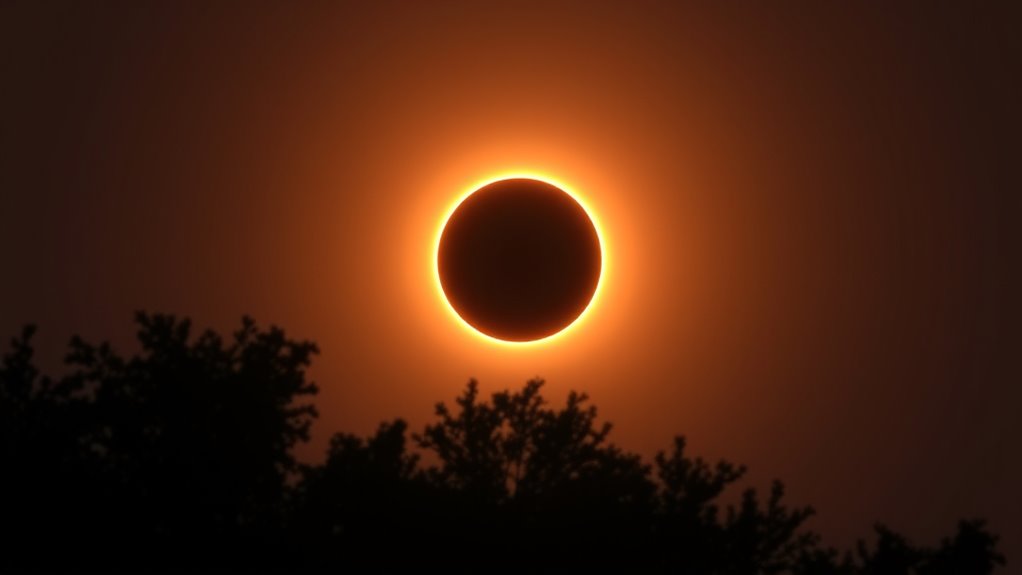
Although solar eclipses occur somewhere on Earth about every 18 months, you won’t see one from the same location that often. On average, there are about two to five solar eclipses globally each year, including partial, annular, and total types.
You might catch a partial eclipse more frequently, but total and annular eclipses are less common. The Moon’s orbit and Earth’s rotation create this regular but scattered pattern.
When you plan to observe an eclipse, you’ll need to track its path carefully since the shadow only covers a narrow area. By understanding the global frequency, you can better anticipate when and where to travel for the next spectacular solar eclipse experience.
Why Are Total Solar Eclipses Rare in One Location?
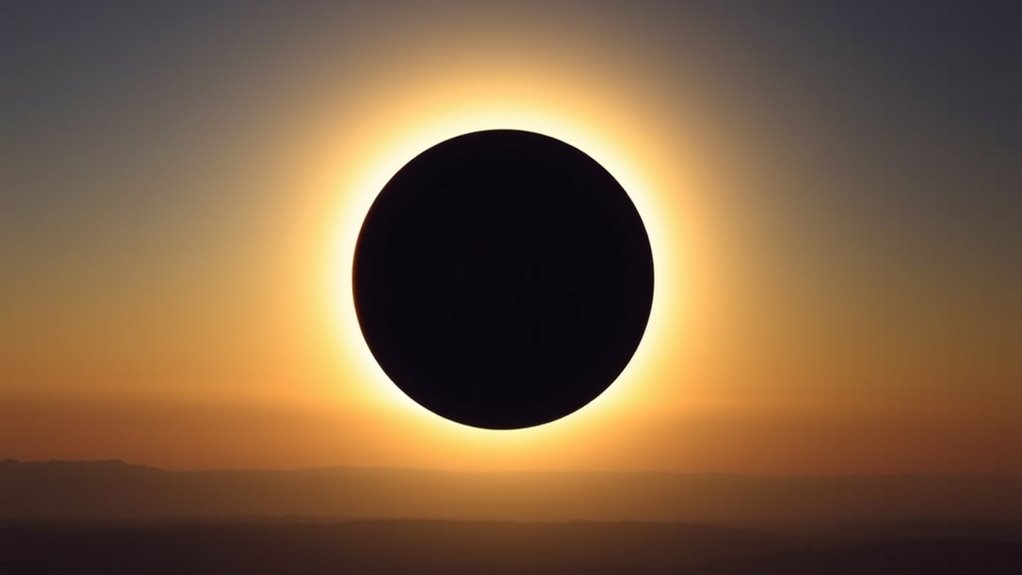
Because the Moon’s shadow traces a narrow path across Earth’s surface, total solar eclipses rarely occur in the same location. You might wonder why this happens so infrequently where you live.
Here’s why: The Moon’s shadow is only about 100 miles wide during totality, making the path very narrow. Earth is constantly rotating, so the shadow moves quickly across different regions.
Also, the Moon’s orbit is tilted, so the alignment needed for a total eclipse is uncommon. Plus, the Earth-Moon-Sun alignment shifts with each eclipse, changing where the shadow falls.
How Is the Path of Totality for a Solar Eclipse Determined?
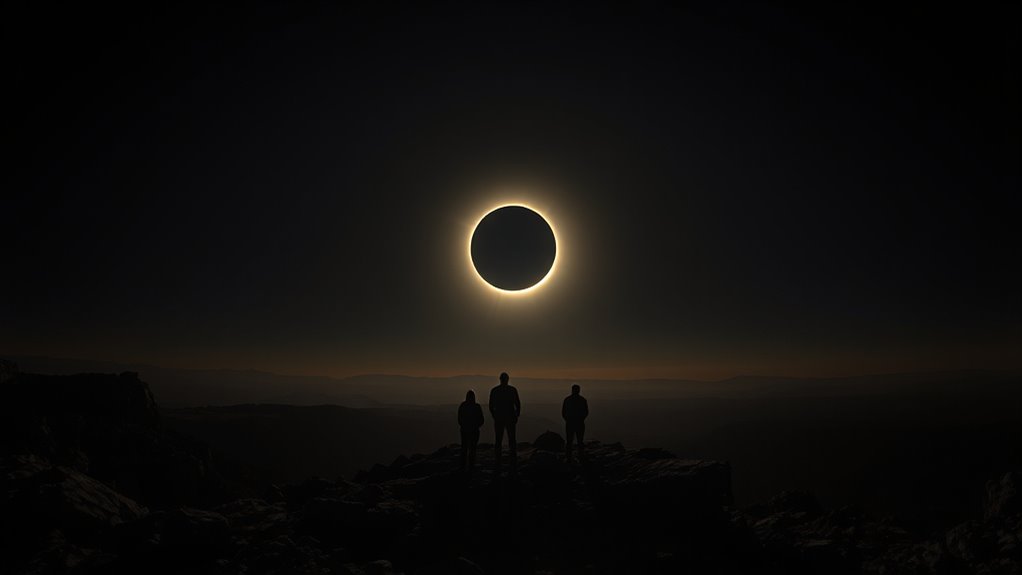
When the Moon passes between the Earth and the Sun, the path of totality forms where the Moon’s shadow touches the Earth’s surface. You can think of this path as a narrow track, usually about 100 to 160 kilometers wide, where the Sun is completely obscured.
The exact location depends on the Moon’s size, distance from Earth, and alignment with the Sun. Because the Moon’s orbit is tilted and elliptical, its shadow sweeps across the Earth at a specific angle and speed, creating that distinct path.
Scientists use precise calculations involving celestial mechanics and geometry to predict this path well in advance. By understanding these factors, you can pinpoint where and when totality will occur during a solar eclipse.
How to Safely Observe a Solar Eclipse
To safely observe a solar eclipse, you must protect your eyes from the Sun’s harmful rays at all times. Looking directly at the Sun without proper protection can cause serious eye damage.
Here’s how you can watch the eclipse safely:
- Use eclipse glasses that meet the ISO 12312-2 safety standard. Regular sunglasses aren’t enough.
- Employ a pinhole projector to indirectly view the eclipse by projecting the Sun’s image onto a surface.
- Use solar filters on telescopes or binoculars—never look through them without these filters.
- During totality, when the Sun is completely covered, you can glance at the eclipse directly. But make sure to put protection back on as soon as the Sun reappears.
Follow these steps to enjoy the eclipse without risking your eyesight.
When and Where Are the Next Solar Eclipses?
Now that you know how to protect your eyes during a solar eclipse, you might be wondering when and where you can catch the next ones. The upcoming solar eclipses offer great opportunities to witness this spectacular event.
The next total solar eclipse will occur on April 8, 2024, visible across parts of North America, including Mexico, the United States, and Canada. Following that, an annular eclipse will take place on October 14, 2023, visible across the western United States, Central America, and South America.
Partial eclipses happen more frequently and can be seen from broader regions. Checking reliable eclipse maps and timing for your location will help you know exactly when to look up.
Keep an eye out—you won’t want to miss these celestial shows!
How to Plan Your Solar Eclipse Viewing Trip
To plan your solar eclipse trip, start by picking a location within the path of totality that offers clear skies. Check the timing carefully to align with the eclipse’s peak and consider local weather patterns to avoid clouds.
With the right spot and timing, you’ll maximize your chances of an unforgettable view. It’s all about being in the right place at the right time!
Choosing The Best Location
Where should you set up your solar eclipse viewing spot? Picking the right location can make your experience unforgettable.
Here’s how to choose:
- Find the path of totality — Make sure your spot lies within this narrow band for the full eclipse.
- Check accessibility — Choose a place that’s easy to get to, with parking or public transport options.
- Look for open spaces — Avoid tall buildings or trees that might block your view.
- Consider safety and comfort — Pick a spot where you can set up chairs, snacks, and eclipse glasses comfortably.
Timing And Weather Considerations
Although solar eclipses happen at precise times, you’ll want to plan your trip carefully to make the most of the event. Check the exact timing for your chosen location well in advance, as even minutes matter.
Arrive early to settle in and avoid missing the vital moments. Weather plays a huge role—clear skies are essential, so research historical weather patterns for your destination during that season.
If possible, have a backup location nearby with better forecasted conditions. Pack appropriate gear like solar glasses and a tripod for steady shots.
Finally, stay flexible; unexpected weather changes can happen, so keep an eye on local updates. By considering timing and weather carefully, you’ll maximize your chances of witnessing this rare and breathtaking spectacle.
Frequently Asked Questions
Can Animals Sense or React to Solar Eclipses?
Yes, animals often sense solar eclipses and react to the sudden darkness. You’ll notice birds quieting, insects stopping, or pets acting confused because they pick up on the unusual changes in light and temperature.
It’s pretty interesting how they can pick up on these shifts, right? Their behavior changes almost like it’s nighttime all of a sudden.
Why Do Solar Eclipses Sometimes Appear as Annular Instead of Total?
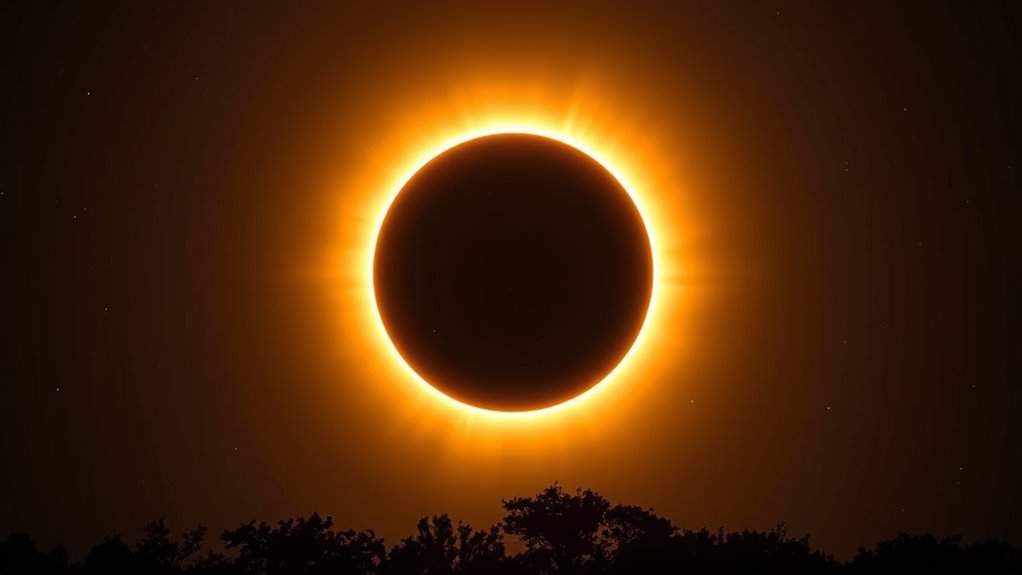
Like a knight mistaking a hologram for a dragon, you’ll see an annular eclipse when the Moon’s too far from Earth to cover the Sun fully, leaving a fiery ring instead of total darkness.
It’s kind of like the Moon is playing a little trick on us, showing off a glowing ring instead of disappearing the Sun completely. Pretty cool, right?
What Cultural or Historical Significance Do Solar Eclipses Have?
You’ll find solar eclipses held deep cultural significance; many ancient societies saw them as omens or divine messages.
You’ll appreciate how they inspired myths, rituals, and even scientific inquiry throughout history.
How Do Solar Eclipses Affect Solar Power Generation?
Think of solar power as a thirsty plant; during an eclipse, it temporarily loses sunlight and halts energy growth. You’ll notice a dip in generation, but once the sun returns, your power blooms back to full strength.
It’s like a quick pause—nothing more. So, no worries, your solar setup bounces right back after the eclipse passes.
Can Solar Eclipses Be Predicted Centuries in Advance?
Yes, you can predict solar eclipses centuries ahead using precise calculations of the moon’s and sun’s orbits. Astronomers use these patterns to forecast eclipses accurately.
This helps you plan observations long before they happen. It’s pretty amazing how we can map out these events so far in advance!
Conclusion
Solar eclipses might happen about two to five times a year globally, but the chance to witness a total solar eclipse from your exact location is only once every 375 years on average. That rarity makes these moments truly special.
So, when you hear about an upcoming eclipse, don’t miss your chance! Plan ahead, follow safety tips, and get ready to experience one of nature’s most breathtaking shows. It’s worth the wait!
Remember, solar eclipses are rare events that offer a unique opportunity to observe the sun’s beauty in a way you never have before. With the right preparation, you can safely enjoy this spectacular natural phenomenon. So mark your calendar and keep an eye out for the next solar eclipse near you!