How to Test Solar Panel Output in 7 Easy Steps
To test your solar panel output in seven easy steps, start by gathering your multimeter, safety gloves, and a ladder. These tools are essential for safely and accurately checking your system’s performance.
Cleaning your panels to remove dirt and debris is a smart first move since a clean surface helps ensure accurate readings.
Next, measure the open-circuit voltage (Voc) and short-circuit current (Isc) under direct sunlight. These measurements give you a good baseline of how your panels are performing in ideal conditions.
Then, check the operating voltage and current using your multimeter to see how your system runs under load.
After that, calculate the power by multiplying voltage and current — this tells you the actual output of your solar panel.
If you notice anything off, troubleshoot performance issues right away to keep your setup running smoothly.
Keep following along to uncover more tips for maintaining and optimizing your solar setup for the best efficiency.
Key Takeaways
– Wear insulated gloves and safety goggles, and use a stable ladder to safely access and inspect solar panels.
Safety first, right? It’s important to protect yourself while working with electrical equipment up high.
– Clean panels thoroughly to remove dirt and debris for accurate voltage and current measurements.
Dirty panels can really mess with your readings, so taking the time to clean them pays off.
– Measure open-circuit voltage (Voc) with a multimeter set to DC voltage under direct sunlight.
Make sure you’re doing this when the sun is shining bright for the best results.
– Measure operating current by connecting the multimeter in series with the panel and load, using the highest current range first.
Starting with the highest range helps avoid damaging your meter or getting inaccurate readings.
– Calculate power output by multiplying measured voltage and current, then compare results to panel specifications for performance assessment.
This step lets you see if your panel is working as it should or if something might need attention.
Prepare Your Tools and Safety Gear for Testing
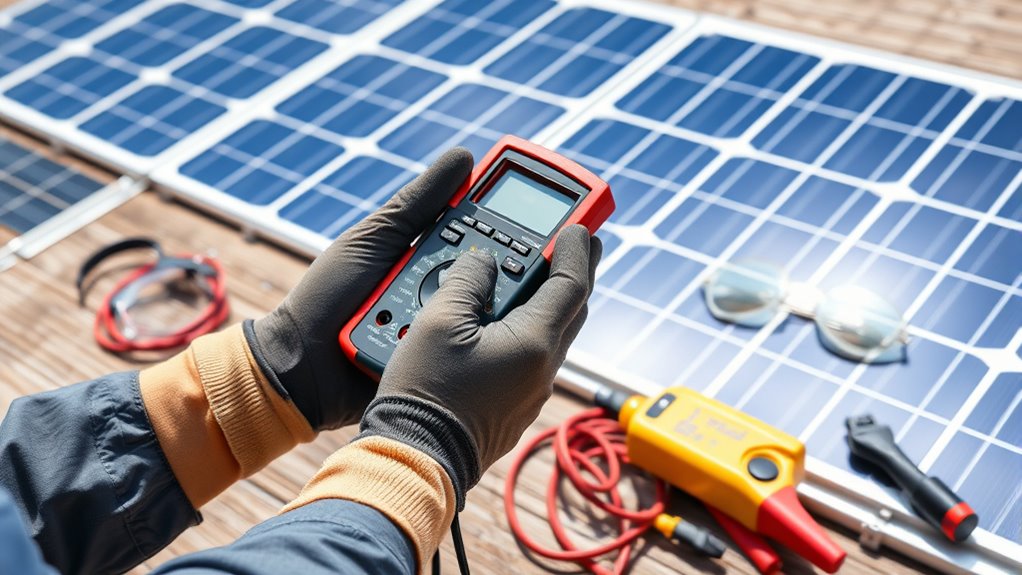
Before you begin testing your solar panel output, gather all necessary tools and safety gear to guarantee a smooth and safe process. You’ll need a digital multimeter to measure voltage and current accurately. Make sure the multimeter’s batteries are fresh, and you understand how to use it.
Wear insulated gloves and safety goggles to protect yourself from electrical shocks and debris. Have a sturdy ladder if your panels are on the roof, and confirm it’s placed on stable ground.
Avoid testing in wet conditions to prevent accidents. Also, carry a notebook or device to record your readings.
Find and Clean Your Solar Panels Before Testing
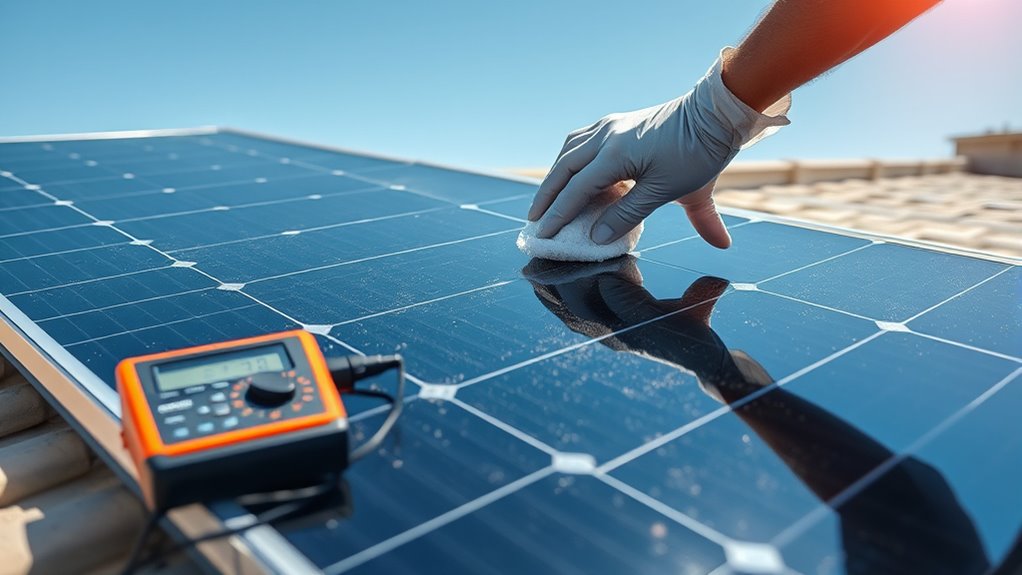
Although it might seem simple, locating and cleaning your solar panels is essential to get accurate output readings. Start by identifying each panel on your roof or mounting structure.
Make sure you have clear access to them to perform a thorough inspection. Dirt, dust, bird droppings, and debris can block sunlight and reduce your panel’s efficiency, skewing your test results.
Use a soft brush or cloth with water and mild soap to gently clean the surface. Avoid abrasive materials or harsh chemicals that could damage the panels.
Rinse thoroughly and let them dry completely before testing. Taking these steps guarantees your readings reflect the panels’ true performance, free from external factors like grime or shading that can distort the output you’ll measure next.
Measure Open-Circuit Voltage (Voc)
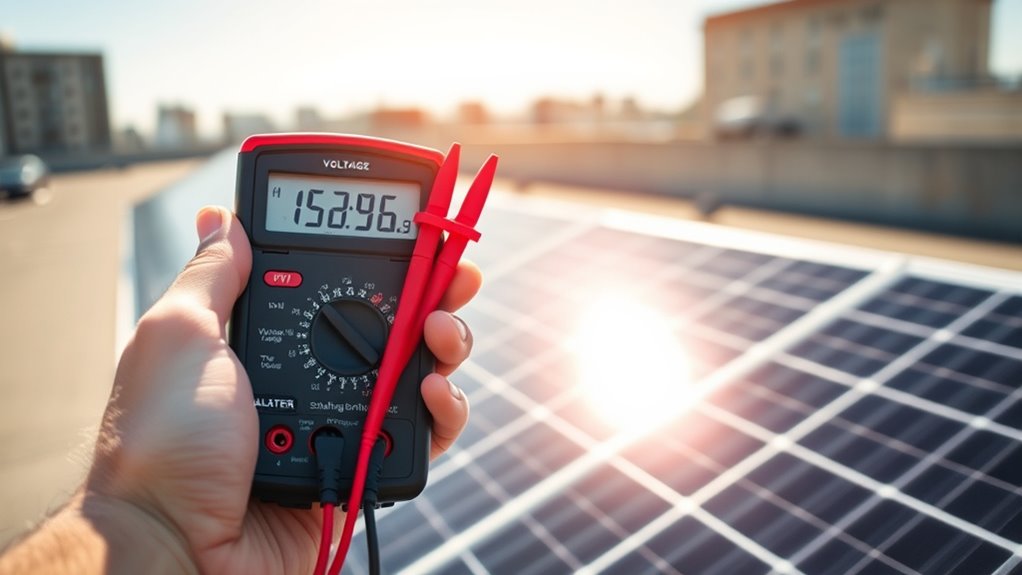
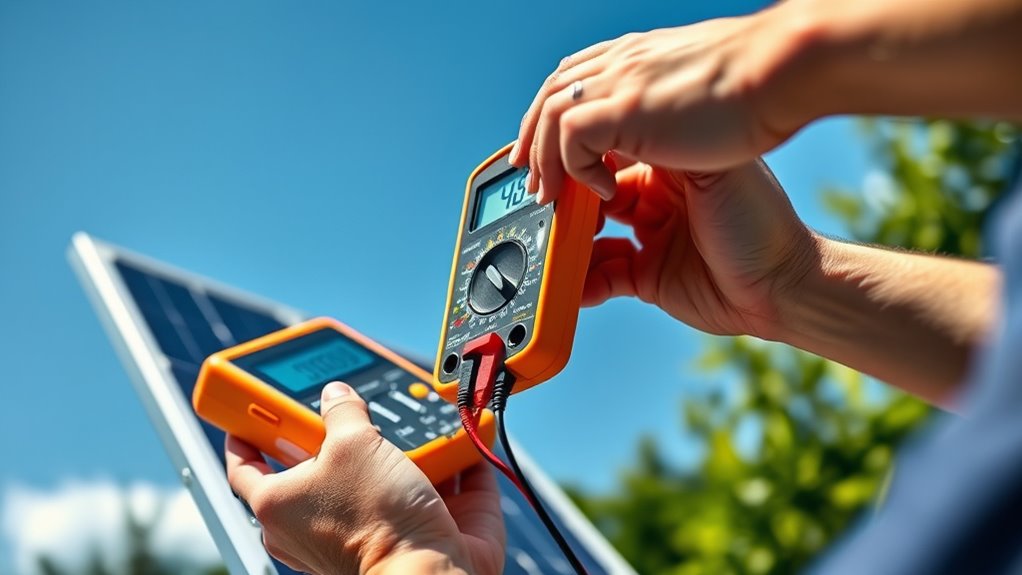
When you measure the open-circuit voltage (Voc), you’re checking the maximum voltage your solar panel can produce without any load connected. To do this, use a digital multimeter set to the DC voltage range.
First, make sure your panel is in direct sunlight and fully exposed. Then, connect the multimeter’s positive lead to the panel’s positive terminal and the negative lead to the negative terminal.
The reading you get is the Voc. This value should match or be close to the panel’s rated Voc found in the specifications.
If it’s notably lower, your panel might be damaged or shaded. Remember, don’t connect any devices during this test, as it must be open circuit to get an accurate voltage measurement.
Test Short-Circuit Current (Isc)
Measuring the short-circuit current (Isc) gives you insight into the maximum current your solar panel can generate under full sunlight. To test Isc, you’ll need a multimeter set to the highest current range.
Disconnect the panel from any load or charge controller. Then, connect the multimeter probes directly to the panel’s positive and negative terminals, effectively short-circuiting the output.
Be cautious, as this creates a direct current flow, but it’s safe for brief testing. The reading you get is the Isc, usually expressed in amperes (A).
Compare this value with the manufacturer’s specifications to check if your panel is performing as expected. Remember, Isc will vary with sunlight intensity, so perform this test on a bright, sunny day for accurate results.
Measure Operating Voltage and Current With a Multimeter
To measure your solar panel’s operating voltage and current, you’ll need the right multimeter set up correctly. Make sure you know how to measure voltage accurately without interrupting the circuit.
Also, follow safety steps when testing current to avoid damaging your equipment or hurting yourself. It’s important to be careful and double-check your settings before you start.
Selecting The Right Multimeter
Although testing your solar panel’s output might seem straightforward, choosing the right multimeter is vital for accurate voltage and current readings. You’ll want a digital multimeter with a sufficient voltage range—at least up to 20 volts DC—to safely measure typical solar panel outputs.
Look for a model that can measure both DC voltage and current since solar panels produce direct current. Accuracy matters, so pick a multimeter with at least 1% accuracy for reliable results.
Also, check that it offers a clear display and easy-to-use functions to avoid errors during testing. If you plan to test current, ensure the multimeter’s current measurement range fits your panel’s output. Always use the proper ports and settings to prevent damage or inaccurate readings.
Measuring Voltage Accurately
Once you have the right multimeter, you can start checking your solar panel’s voltage output. First, set your multimeter to measure DC voltage (V with a straight line).
Connect the red probe to the positive terminal and the black probe to the negative terminal of the solar panel. Make certain the panel is exposed to sunlight for accurate readings.
The display will show the panel’s open-circuit voltage, which indicates its operating voltage under no load. Avoid touching the probes together during measurement to prevent damage.
If you get a reading of zero or an unusually low voltage, double-check your connections and confirm the panel is in direct sunlight. Measuring voltage accurately helps you verify if your solar panel is functioning as expected before testing current.
Testing Current Safely
Before measuring current, make sure you know how to safely connect your multimeter in series with the solar panel and load. Connecting the meter the wrong way can damage your device or give you inaccurate readings. Always set your multimeter to the proper current setting and start with the highest range to avoid blowing a fuse.
Remember, current measurements mean the meter has to be part of the circuit, so never connect it directly across the panel terminals.
Keep these tips in mind:
- Set your multimeter to the right current range (mA or A).
- Break the circuit to insert the meter in series.
- Use insulated probes and avoid touching bare wires.
- Double-check connections before powering the panel.
- Start with no load, then add it gradually for safe readings.
Following these steps helps you get accurate and safe current measurements every time.
Calculate Your Solar Panel’s Power Output
Now that you’ve measured the voltage and current, it’s time to calculate your solar panel’s power output. Start by checking the panel’s specifications for reference values.
Then, multiply your measured voltage by the current to find the actual power your panel is producing. It’s pretty straightforward once you have those numbers. Just a quick calculation, and you’ll know how much energy your panel is generating.
Understand Panel Specifications
Although testing your solar panel’s output requires hands-on measurements, understanding its specifications is essential for accurate calculations. You need to know what each rating means to estimate your panel’s potential power correctly.
Key specs are usually found on the panel’s label or datasheet, and they guide your expectations.
Focus on these important specifications:
- Maximum Power (Pmax): The highest wattage the panel can produce under ideal conditions.
- Open-Circuit Voltage (Voc): Voltage when no load is connected.
- Short-Circuit Current (Isc): Current when the circuit is closed with no resistance.
- Voltage at Maximum Power (Vmp): Voltage at which the panel delivers maximum power.
- Current at Maximum Power (Imp): Current at which the panel delivers maximum power.
Knowing these helps you predict and compare output before testing. It makes the whole process a lot easier!
Measure Voltage And Current
With the panel’s specifications in hand, you can move on to measuring its actual voltage and current output. First, set your multimeter to measure DC voltage and connect its probes to the panel’s positive and negative terminals.
Be sure the panel is under direct sunlight for accurate readings. Note the voltage displayed and compare it with the panel’s rated voltage.
Next, switch your multimeter to measure current (amperage). To do this, you’ll need to connect the meter in series with the panel and the load or a suitable test resistor.
Carefully connect the positive lead from the panel to the multimeter’s positive input, and the multimeter’s negative output to the load’s positive terminal. Record the current reading, which indicates the flow of electricity your panel is producing at that moment.
Calculate Power Output
How do you determine the actual power output of your solar panel? Simply multiply the voltage (V) by the current (I) your panel produces. This calculation gives you the power in watts (W), showing how much energy your panel generates under specific conditions.
To get an accurate reading, remember these key points: use a multimeter to measure voltage and current. Take readings under full sunlight, ideally around midday.
Make sure your panel is clean and angled correctly. Then, calculate power output using the formula: Power (W) = Voltage (V) × Current (I). Finally, compare your results to the panel’s rated wattage to see how efficient it really is.
Troubleshoot Common Solar Panel Output Issues
If your solar panels aren’t producing the expected power, you’ll want to identify the root cause quickly to restore peak performance. Start by checking for obvious issues like dirt, debris, or shading on the panels, as these can drastically reduce output.
Next, inspect wiring and connections for corrosion or damage that might interrupt power flow. Use a multimeter to test voltage at various points, ensuring the panels and inverter work correctly.
Also, verify that the inverter’s LED indicators show normal operation. If performance remains low, consider panel degradation or faulty cells, which may require professional evaluation.
Regularly troubleshooting these common problems helps you maintain ideal solar panel output and maximize your energy savings. It’s worth the effort to keep things running smoothly!
Frequently Asked Questions
How Do Temperature Changes Affect Solar Panel Output?
You’ll notice solar panels produce less power as temperatures rise because heat reduces their efficiency. Cooler conditions boost output, so your panels work best on sunny, cool days rather than hot, sunny ones.
It’s kind of interesting, right? Even though the sun is shining bright, too much heat can actually slow down your solar panels. So, if you’re hoping to get the most out of your setup, those crisp, cool days are where it’s at!
Can Shading From Nearby Objects Permanently Damage Panels?
Shading from nearby objects usually won’t permanently damage your solar panels, but it can reduce their efficiency considerably. You’ll want to keep panels clear to avoid hotspots that might cause long-term issues if persistent.
It’s a good idea to check your panels regularly. That way, you can catch any shading problems early and keep everything running smoothly.
What Is the Lifespan of a Typical Solar Panel?
You can expect a typical solar panel to last about 25 to 30 years. Over time, its efficiency slowly drops.
But with proper care, it’ll keep producing power well beyond that lifespan. It’s pretty impressive how long they can keep going!
How Often Should Solar Panels Be Professionally Inspected?
You should get your solar panels professionally inspected at least once a year.
For example, a homeowner noticed a 15% efficiency drop after skipping inspections. But annual checks helped restore full performance quickly.
Are There Apps to Monitor Solar Panel Performance Remotely?
Yes, you can use apps like SolarEdge, Enphase Enlighten, or Tesla to monitor your solar panel performance remotely. They provide real-time data, alerts, and system health updates.
This makes it super easy to track your energy production anytime. So, whether you’re at home or on the go, you’ve got full control and insight into how your solar setup is doing.
Conclusion
Testing your solar panel output is like tuning a musical instrument—each step guarantees your system plays at its best. By preparing your tools, cleaning panels, and carefully measuring voltage and current, you’ll get a clear picture of your panel’s health.
Calculating power output and troubleshooting any issues keeps your solar setup humming efficiently. Follow these simple steps, and you’ll shine a bright light on your energy’s true potential.
Regularly testing your solar panel output is key to maintaining an efficient and reliable solar energy system. It helps you spot any problems early and ensures you’re getting the most power from your panels. By following these easy steps, you’re not just checking your system—you’re optimizing your solar investment for the long run. So, take the time to test your solar panel output and keep your clean energy flowing strong!