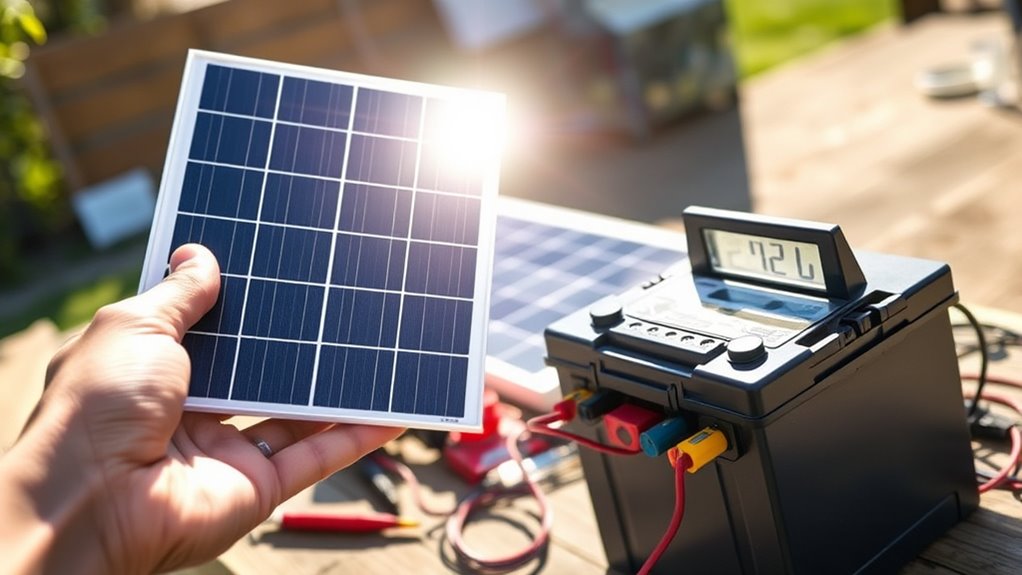
How to Choose the Right Size Solar Panel to Charge a 12 Volt Battery
To choose the right solar panel size for charging a 12-volt battery, start by figuring out your battery’s watt-hour capacity. You do this by multiplying its amp-hours by 12 volts. This gives you a clear idea of how much energy your battery can store.
Next, estimate how much energy you use daily. Don’t forget to consider the average sunlight hours you get, including any seasonal changes that might affect this. These details help you pick a panel wattage that can recharge your battery effectively.
A good rule of thumb is to look for a solar panel wattage that’s around 10-20% of your battery’s watt-hour capacity per peak sun hour.
Getting the right size is important—it prevents battery damage and ensures reliable charging. Keep exploring to learn how panel efficiency and other system factors come into play.
Key Takeaways
- Calculate battery capacity in watt-hours by multiplying amp-hours (Ah) by 12V to determine energy storage needs.
- Choose solar panel wattage to replenish 10-20% of the battery’s watt-hour capacity per peak sunlight hour.
- Account for seasonal sunlight variations and weather to ensure reliable year-round battery charging.
- Select panels with sufficient wattage and efficiency to fully charge the battery within your desired time frame.
- Use proper wiring and connections to minimize energy losses and prevent under- or overcharging of the battery.
How to Calculate Your 12 Volt Battery’s Solar Panel Needs
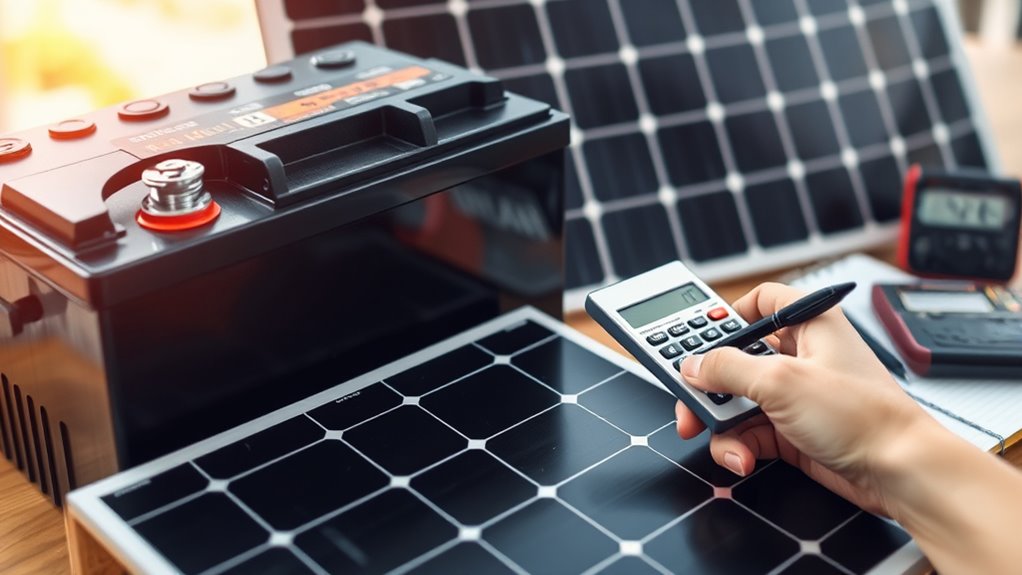
How do you determine the right solar panel size for your 12-volt battery? Start by knowing your battery’s capacity in amp-hours (Ah). Multiply that by the battery voltage (12V) to get watt-hours (Wh).
For example, a 100Ah battery stores about 1,200Wh (100Ah × 12V). Next, estimate how much energy you use daily to understand how much the panel must generate.
Divide your daily energy need by the battery voltage to find the amp-hours you’ll recharge each day. Then, choose a solar panel that can supply at least this amount of power under ideal conditions.
This way, you make sure your panel can recharge the battery fully without overloading or undercharging it. This calculation sets a solid foundation for sizing your solar system effectively.
How Sunlight Hours Affect Solar Panel Sizing
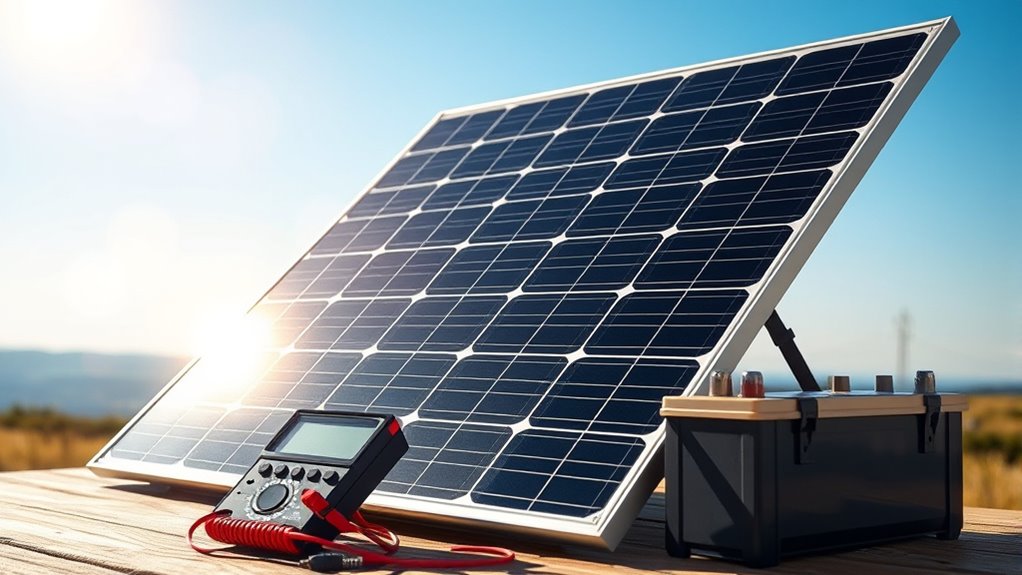
To size your solar panel correctly, you need to take into account the average daily sunlight your location receives. Keep in mind that sunlight hours can change with the seasons, affecting your panel’s efficiency.
Understanding these variations helps you choose a panel that meets your energy needs year-round. It’s all about matching the panel to the light you actually get, not just the ideal conditions. That way, you won’t end up with too little power or paying for more than you need.
Average Daily Sunlight
The number of sunlight hours your location receives each day plays a crucial role in determining the size of your solar panel system. More sunlight means your panels can generate more power in less time, so you can get by with smaller panels.
Conversely, fewer sunlight hours require larger panels to meet your battery’s charging needs.
Here’s a quick look at how average daily sunlight impacts panel sizing:
| Location | Avg. Sunlight Hours | Suggested Panel Size (Watts) |
|---|---|---|
| Phoenix, AZ | 7.5 | 100 |
| Miami, FL | 6.0 | 125 |
| Seattle, WA | 4.0 | 180 |
| Chicago, IL | 5.0 | 150 |
| Denver, CO | 6.5 | 120 |
Seasonal Sunlight Variations
While average daily sunlight gives you a baseline for panel sizing, seasonal changes can considerably impact your system’s performance throughout the year. During winter months, shorter days and lower sun angles reduce the amount of usable sunlight your panel receives.
This means your solar panel might produce less energy when you need it most. To compensate, you should size your panel based on the lowest sunlight period, guaranteeing your battery still charges adequately during those months.
Conversely, in summer, longer sunlight hours provide excess energy, which can help recharge your battery faster. By accounting for these seasonal variations, you avoid undersizing your system and assure consistent battery charging year-round, no matter the season.
This approach maximizes reliability and efficiency in your solar setup. It’s a smart move that keeps your energy flowing smoothly all year long.
Why Your Solar Panel’s Wattage Really Matters

Because wattage determines how much energy your solar panel can produce, it directly impacts your system’s efficiency and your savings.
Choosing a panel with the right wattage guarantees you generate enough power to meet your needs without overspending on unnecessary capacity.
If your panel’s wattage is too low, you’ll charge your battery slowly or not fully, especially on cloudy days.
Here’s a quick comparison to help you understand wattage impact:
| Wattage (W) | Approx. Daily Energy (Wh) |
|---|---|
| 50 | 200 – 250 |
| 100 | 400 – 500 |
| 150 | 600 – 750 |
This table shows how higher wattage panels provide more energy, improving your battery’s charge speed and overall performance.
How to Match Solar Panel Wattage to Battery Capacity
When you match your solar panel’s wattage to your battery capacity, you guarantee efficient charging without wasting energy or overloading your system. To get it right, consider these three key steps:
- Calculate Battery Capacity in Watt-Hours (Wh): Multiply your 12V battery’s amp-hour (Ah) rating by 12 to find its total energy storage capacity.
- Determine Solar Panel Wattage: Choose a panel wattage that can fully recharge your battery in a reasonable time. Usually, this means around 10-20% of the battery’s watt-hour capacity per hour of peak sunlight.
- Factor in System Losses: Account for inefficiencies like wiring and charging losses by increasing panel wattage by 10-20%. This helps ensure reliable charging.
Following these steps helps you select a solar panel sized perfectly for your battery’s needs. It’s a simple way to keep your system running smoothly!
How Charging Time and Efficiency Affect Your Solar Setup
You’ll want to think about how charging time depends on your solar panel’s efficiency and your battery’s capacity. A more efficient panel charges your battery faster, but larger batteries naturally take longer to fill.
Understanding these factors helps you pick the right panel size for your setup. It’s all about balancing speed and size so your system works just right for your needs.
Charging Time Factors
Although solar panels vary widely in size and power, the time it takes to charge your devices or batteries depends heavily on factors like panel efficiency, sunlight availability, and your energy needs.
To better understand charging time, consider these key factors:
- Sunlight Hours: More direct sunlight means faster charging. Cloudy days or shading reduce the panel’s output and increase charging time.
- Battery Capacity: Larger batteries take longer to charge. Knowing your battery’s amp-hour rating helps you estimate charging duration.
- Energy Consumption: If you use power while charging, the net charge rate drops, extending the time needed to reach full capacity.
Solar Panel Efficiency
Because solar panel efficiency directly impacts how quickly your system converts sunlight into usable energy, understanding this factor helps you optimize your setup. Higher efficiency means more power generated from the same sunlight, reducing charging time.
However, efficient panels often come at a higher cost. You’ll want to balance efficiency with your budget and space constraints.
Here’s a quick overview of common panel efficiencies and their effect on charging:
| Efficiency (%) | Power Output (Watts) | Charging Speed | Cost Impact | Space Required |
|---|---|---|---|---|
| 15 | Low | Slow | Low | Larger |
| 17 | Moderate | Moderate | Moderate | Medium |
| 20 | High | Fast | Higher | Smaller |
| 22 | Very High | Very Fast | Highest | Smallest |
Choosing the right efficiency helps you meet your charging needs efficiently.
Battery Capacity Impact
When selecting a solar panel system, understanding how battery capacity influences charging time and efficiency is essential. Your battery’s capacity, measured in amp-hours (Ah), determines how much energy it can store and how long it takes to fully charge.
Larger capacity batteries require more energy, meaning longer charging times and potentially larger solar panels. It’s important to keep this in mind when planning your system.
Consider these three key points:
- Charging Time – Bigger batteries need more current, so smaller panels may struggle to recharge them quickly.
- Panel Size Matching – Choose a panel that can supply at least 10-20% more current than your battery’s capacity to ensure efficient charging.
- Energy Losses – Higher capacity setups may experience more energy loss, so factor in some extra panel wattage to compensate.
Matching your solar panel size to battery capacity guarantees maximum performance and battery health. This way, you avoid undercharging and keep everything running smoothly.
Tips for Avoiding Common Solar Panel Sizing Mistakes
To avoid common solar panel sizing mistakes, you need to carefully assess your energy needs before making any decisions. Start by calculating your daily power consumption in watt-hours to guarantee the panel can generate enough energy.
Carefully assess your energy needs by calculating daily watt-hours before choosing a solar panel.
Don’t overlook the effects of weather and shading, which reduce output—plan for less than ideal conditions. It’s better to be safe than sorry when estimating how much power you’ll actually get.
Avoid choosing a panel solely based on voltage; wattage matters more for charging efficiency. Also, don’t forget to factor in the battery’s capacity and charging requirements to prevent under- or overcharging.
Finally, double-check your wiring and connections to minimize energy loss. By following these tips, you’ll select the right panel size that reliably charges your 12-volt battery without wasting resources or causing damage.
Frequently Asked Questions
Can I Use a Solar Panel Charger Controller With Any 12V Battery?
Yes, you can use a solar panel charge controller with any 12V battery. Just make sure the controller matches your battery type and capacity to avoid damage.
It’s important to check compatibility for peak charging and battery life maintenance. That way, your battery stays healthy and works efficiently.
What Types of Solar Panels Are Best for Charging 12V Batteries?
You’ll find monocrystalline panels best for charging 12V batteries because they’re efficient and durable.
While polycrystalline panels work, they’re less efficient. Amorphous panels are cheaper but need more space.
Choose based on your needs. It really depends on what matters most to you—efficiency, cost, or space.
How Do Temperature Changes Affect My Solar Panel’s Performance?
You’ll notice your solar panel’s performance drops as temperatures rise because heat reduces voltage output. Cooler temps improve efficiency, so keep panels ventilated and shaded when possible to maximize their charging power.
It’s pretty simple—when it gets hot, your panels don’t work as well. So, giving them some airflow and shade can really help keep them running strong.
Is It Safe to Connect Multiple Solar Panels in Series or Parallel?
Think of panels as friends holding hands—series connects their strength end-to-end, raising voltage; parallel joins side-by-side, boosting current.
You can safely connect them both ways, but match specs to avoid short circuits or damage.
Just make sure the panels have similar ratings. Otherwise, things might not work out as planned.
How Often Should I Clean My Solar Panels for Optimal Charging?
You should clean your solar panels every 1 to 3 months, depending on your environment. Dust, dirt, and debris reduce efficiency, so regular cleaning guarantees peak charging.
This keeps your system working at its best. It’s a simple step that really pays off in the long run.
Conclusion
Now that you know how to size your solar panel perfectly for your 12-volt battery, don’t rush into picking any panel. The right choice can mean the difference between endless power and frustrating downtime.
Imagine harnessing the sun’s energy exactly when you need it most. But choose poorly, and you might just miss out. So, take a moment, double-check your calculations, and get ready to power your world efficiently and reliably.
Choosing the right size solar panel to charge a 12-volt battery is key to getting consistent energy. It ensures your battery charges fully without overloading or wasting power. By carefully selecting the correct panel size, you maximize efficiency and enjoy uninterrupted power for your needs. Remember, a well-sized solar panel means your 12-volt battery stays charged and ready whenever you need it most.